If you’ve ever watched a robot arm pick up a part on a factory floor and thought, I want to understand how that actually works, you’re in exactly the right place. An Arduino robot arm kit is a tabletop mechanical arm — usually 40–60 cm tall — controlled by an Arduino microcontroller (a small, programmable circuit board, roughly the size of a credit card) that you wire up and program yourself. These kits range from about $30 for a simple three-axis toy to $300+ for a full six-axis system with intelligent servo feedback. They’re sold as educational tools for teens, as serious maker projects for adults, and increasingly as gateway hardware for engineers and operations managers who want to build hands-on intuition before committing to a $15,000–$45,000 collaborative robot (“cobot”) purchase. This guide will help you choose between the two main kit architectures — 5DOF and 6DOF — explain why “bus servo feedback” is worth paying for, and show you exactly where the upgrade path leads from a $150 kit to a Universal Robots UR3e.
5DOF vs. 6DOF: The Number That Changes Everything
DOF stands for degrees of freedom — the number of independent axes the arm can rotate around. Think of it this way: your shoulder has 3 DOF (it can swing forward/back, side to side, and rotate). Your elbow adds 1. Your wrist adds 2 more. A human arm from shoulder to wrist is roughly 6DOF. That number matters enormously for what the arm can actually do.
Budget Tier — 5DOF Kits
5DOF kits (five axes of rotation) are the dominant entry-to-mid tier, typically priced between $60 and $180. They can reach most points in their workspace, but they cannot freely orient the end effector (the gripper or tool at the tip) at an arbitrary angle while holding a fixed position. In plain English: a 5DOF arm can grab something from directly above, or from the side, but not both at once without repositioning. For pick-and-place demos, drawing, and most classroom tasks, that limitation is acceptable. For anything resembling real industrial work — welding, assembly, dispensing — it becomes a constraint quickly.
Most 5DOF kits at this price point use standard PWM servos with no position feedback, acrylic frames, and example code that gets you moving in an afternoon. Assembly complexity is low, programming complexity is low, and the experience is well-suited to a first introduction to robotics. The tradeoff is that very little of what you learn here maps directly onto the control paradigms used in professional cobot systems.
 product image](/images/external/7904e87a32d1.jpg)
Adeept
$59.99
In stock on Amazon
Check price on AmazonMid-Tier — 6DOF Kits with PWM Servos
6DOF kits add one full wrist-rotation axis and unlock what roboticists call dexterous manipulation: the arm can reach the same point in space from multiple approach angles. Published specifications across the mid-tier 6DOF category — covering platforms such as Yahboom, LewanSoul, and comparable offerings — show working radii of 250–320 mm and payload capacities of 200–500 g. Those numbers are modest, but sufficient for handling small components, markers, and lightweight tools.
IEEE Spectrum’s ongoing coverage of cobot fundamentals consistently identifies 6DOF as the minimum configuration for tasks that transfer meaningful skills to industrial arms. The UR3e, for reference, is also 6DOF, with a 500 mm reach and a 3 kg payload. A 6DOF kit priced between $150 and $250 that still uses PWM servos sits in a useful middle ground: higher task fidelity than a 5DOF arm, lower debugging overhead than a full bus servo system, and an accessible price point for classroom programs or individual learners who aren’t yet ready to commit to the full bus servo ecosystem.
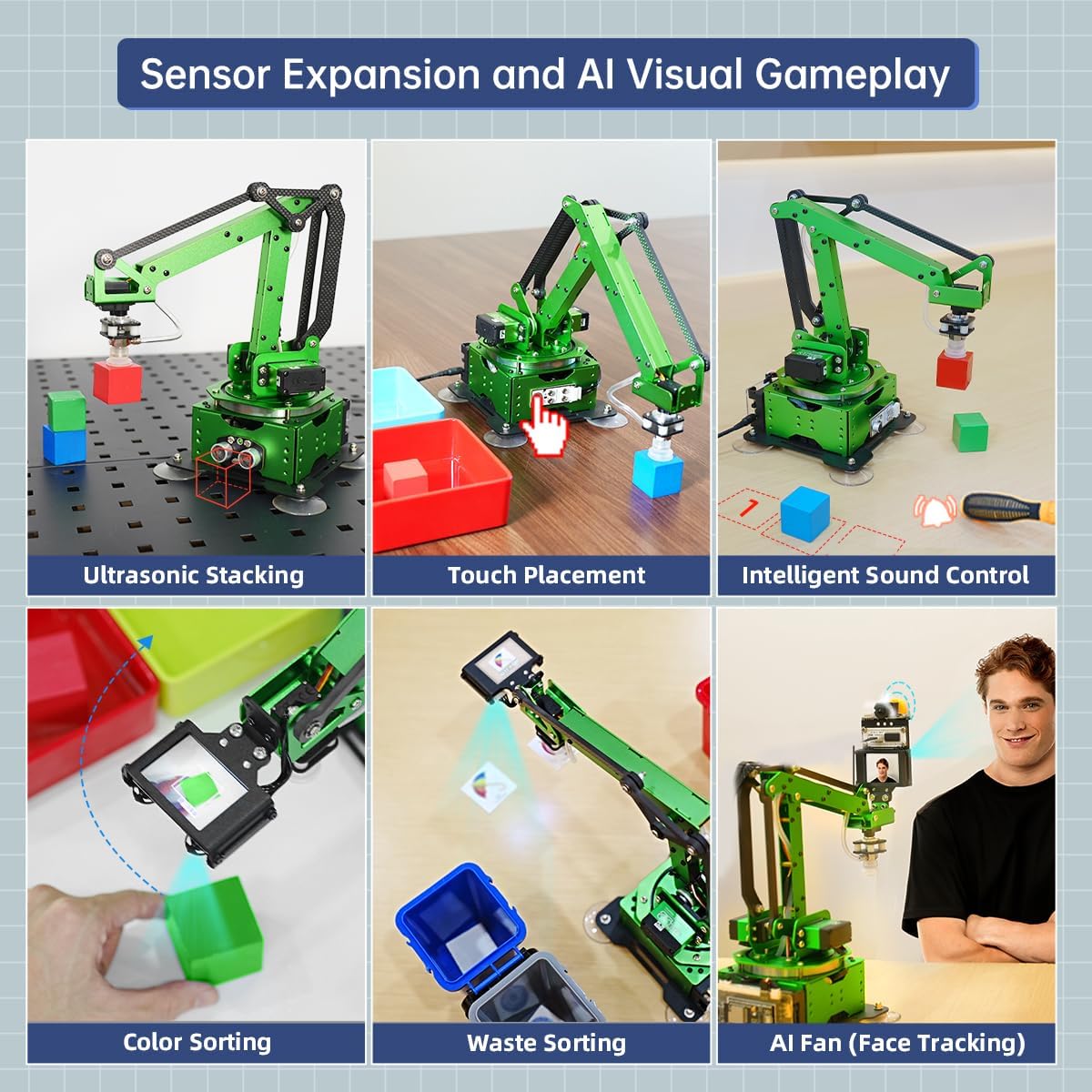
LewanSoul
$159.99
In stock on Amazon
Check price on AmazonPremium Tier — 6DOF Kits with Bus Servo Feedback
The top of the hobbyist arm category — typically $250 to $420 when you include a power supply and at least one gripper — combines the 6DOF architecture with bus servo motors. These kits represent the closest analog to a real cobot available for under $500, and they are the right choice for serious adult makers, STEM educators building competition-preparation programs, and engineers who want to de-risk a cobot procurement decision.
Bus servo technology and its implications are covered in detail in the next section. The short version: these kits report position, temperature, load, and voltage back to your controller in real time. That changes not just what the arm can do, but what you learn while operating it — which is the entire point at this tier.
 product image](/images/external/2f84faa2c01c.jpg)
Robotic
$199.99
In stock on Amazon
Check price on AmazonBus Servo Feedback: The Upgrade That Changes How You Debug
Most sub-$100 kits use PWM servos — motors that receive a simple pulse-width signal telling them where to go, with no way to report back where they actually ended up. This works fine until the arm hits an obstacle, loses steps under load, or drifts over time. You’ll know something went wrong only when the arm is already in the wrong position. For a classroom demo, that’s frustrating. For anything resembling real process work, it’s unacceptable.
Bus servos — the technology used by LX-16A, ST series, and Feetech SCS series motors, among others — communicate over a shared serial bus. Each motor carries a unique ID and can report back its current position, temperature, load, and voltage in real time. Hackaday’s in-depth coverage of hobbyist bus servo architectures describes this category of feedback as the single biggest quality-of-life improvement in the sub-$500 arm segment over the past several years. That framing holds up in practice: owners across aggregated community discussions consistently note that bus servo systems reduce debugging time dramatically compared to PWM arms of equivalent mechanical complexity.
What feedback actually unlocks:
- Closed-loop position correction. The arm knows if it missed a target and can attempt correction without a full reset cycle.
- Collision detection via load monitoring. If a motor’s reported torque spikes suddenly, your code can halt the arm — a primitive but real safety behavior that mirrors how industrial cobots handle unexpected contact.
- Condition monitoring. Motor temperature and voltage data let you catch problems before a servo burns out during a demo or a competition run.
- Teachable trajectories. Most bus servo arms support a “torque-off, record positions” workflow: you physically guide the arm through a motion, record the joint angles at each waypoint, and play them back. Make:’s coverage of Arduino arm projects highlights this teach-and-playback mode as the feature that most directly builds cobot-relevant intuition, because it is conceptually identical to the lead-through programming mode on arms like the UR3e or the Dobot Magician.
Price context across the full category:
| Configuration | Typical Price Range |
|---|---|
| PWM servo kit, 5DOF, no feedback | $45–$120 |
| Bus servo kit, 6DOF, full feedback | $180–$320 |
| Bus servo kit with ROS-compatible controller | $280–$420 |
| Entry cobot (Dobot Magician Elite, 4DOF) | ~$2,500 |
| Mid-tier cobot (UR3e, 6DOF, 3 kg payload) | ~$35,000 fully integrated |
The jump from $320 to $2,500 is real, but the skill you build with a $320 bus servo arm — inverse kinematics intuition, teach-pendant workflow, load monitoring logic — transfers directly at every subsequent price point.
Hidden Costs and Compatibility Surprises
This is where kit shoppers consistently get caught off guard. The sticker price on most Arduino arm kits covers the mechanical assembly and the servo motors. It often does not cover the following.
Software and firmware gaps. Most kits ship with basic example code, but owners regularly report spending 4–12 hours achieving a clean ROS (Robot Operating System — the open-source middleware that most serious robotics work runs on) integration. The Robot Report’s coverage of SME cobot adoption notes that ROS2 familiarity is increasingly listed as a hiring criterion for automation technicians, which means time spent on this integration has genuine career value, not just hobbyist value.
Controller board mismatches. Several popular 6DOF bus servo kits ship with proprietary controller boards that use non-standard serial protocols. Third-party tools — MoveIt! motion planning, for instance — will not communicate with them without a translation layer. Verify explicitly that a kit claims ROS compatibility before purchasing, not after.
Gripper accessories. Suction cup and parallel jaw grippers are sold separately on virtually every platform in this tier. Budget $15–$40 per gripper type. The gripper is often the deciding factor in whether a particular task is achievable, and kit product pages routinely show gripper-equipped arms without including grippers in the base price.
Power supplies. Bus servo arms at 6DOF typically require a dedicated 5V/10A or 7.4V regulated supply. USB power drawn from a laptop will brownout the servos under load. This $15–$25 add-on is one that multiple owners describe discovering the hard way.
Structural flex under load. Mid-tier acrylic-frame arms flex noticeably at full extension under even 200 g payloads, based on aggregated owner reports. Aluminum-frame kits cost $50–$100 more but hold position measurably better — relevant if you are recording repeatable trajectories for a classroom demonstration or any precision task.
The Upgrade Path: From Kit to Cobot, Mapped Out
Robotics and Automation News’s coverage of SME cobot adoption trends identifies prior hands-on exposure to robot arm kinematics as the single most consistent predictor of faster procurement and integration decisions at the $15,000–$50,000 tier. Here is what that upgrade path looks like in practice.
Stage 1 — Kit ($150–$420): You’re learning joint-space versus task-space control, getting comfortable with inverse kinematics libraries, and building muscle memory around teach-and-playback workflows. A bus servo 6DOF arm with a ROS-compatible board is the right tool here. This stage typically takes 3–9 months of serious weekend work.
Stage 2 — Entry Cobot ($2,500–$8,000): Platforms like the Dobot Magician Elite or myCobot from Elephant Robotics occupy this tier. These are real-payload, safety-rated arms with polished software ecosystems. The programming paradigms built at Stage 1 transfer directly. The procurement conversation shifts to safety certification, workspace integration, and software licensing — not kinematics fundamentals, which you already understand.
Stage 3 — Mid-Tier Cobot ($15,000–$45,000): UR3e, Techman TM5-700, or Dobot CR3. Now you’re in SME-relevant territory. IEEE Spectrum’s cobot coverage notes that Universal Robots arms have become a de facto common language in the collaborative robotics space — integrators, end-effector manufacturers, and vision system vendors all treat the UR interface as the baseline for compatibility claims. An engineer who can fluently discuss joint limits, TCP (tool center point) calibration, and payload envelopes — built through Stage 1 and Stage 2 experience — arrives at this conversation with real credibility.
Stage 4 — Industrial Platform ($50,000–$200,000+): Fanuc, ABB, Yaskawa. The procurement process is entirely different at this level — you’re working with system integrators, not buying off a product page. But the conceptual vocabulary built at every earlier stage is the same vocabulary these systems use.
The Decision, Plainly Stated
- If you’re buying for a teen or a first exploration of robotics: a 5DOF PWM kit in the $60–$120 range is appropriate. Don’t over-invest at this stage.
- If you’re a serious adult maker, a STEM educator building a competition-prep program, or an engineer who wants to de-risk a cobot evaluation: buy a 6DOF bus servo kit with a ROS-compatible controller board, budget $250–$420 all-in including power supply and at least one gripper, and commit to the ROS2 learning curve. The return on that investment is real and documented.
- If you’re an operations manager evaluating cobots: buy one of these kits and give it to your most mechanically curious technician for three months before the UR3e demo visit. You will get sharper questions, faster integration, and fewer surprises in the statement of work.
The gap between a $300 Arduino arm and a $35,000 cobot is large in price and small in conceptual distance. Closing that conceptual gap before you’re writing purchase orders is exactly what these kits are for.