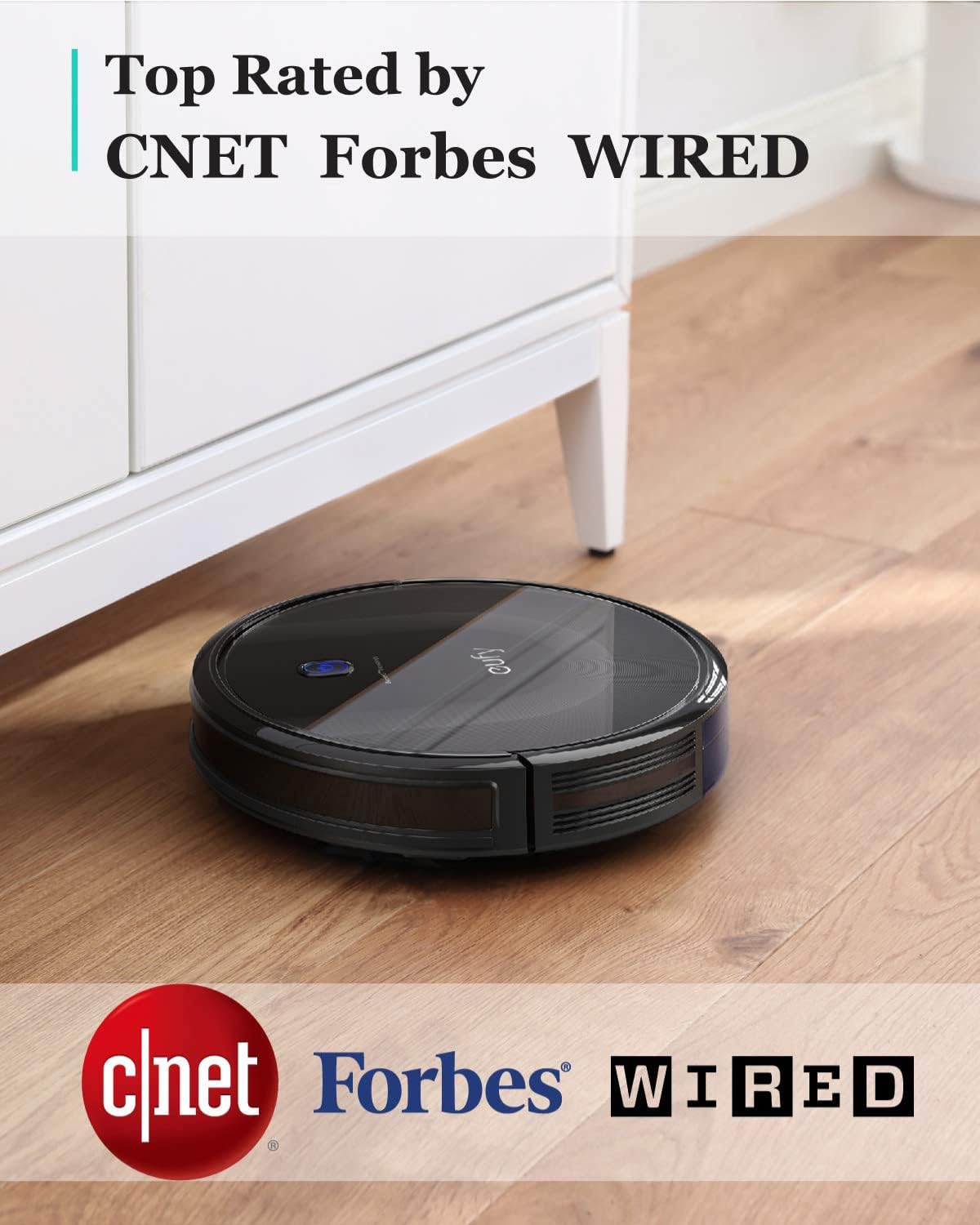
If you’ve heard the term “robot vacuum” but haven’t bought one yet, here’s the quick version: it’s a disc-shaped autonomous device — typically 3–4 inches tall — that rolls around your floor on its own, sucking up dust and debris, then returns to a charging dock when it’s done or running low on power. The fancy models use LiDAR (laser-based room scanning) or cameras to build a map of your home and follow a logical grid pattern. The budget models under $80 — the ones we’re evaluating here — skip all that. They use what’s called random-bounce navigation: the robot moves in a straight line until it hits something, then picks a new angle and keeps going. No app. No Wi-Fi. No map. Just press a button and let it run. That sounds like a compromise — and it is — but depending on your situation, it might be exactly the right compromise.
This guide is for buyers who already understand the broader robot vacuum landscape and are making a deliberate, eyes-open decision about the lower tier. Maybe you want a second unit for a bedroom floor. Maybe you’re outfitting a rental property. Maybe you want to test whether your household will actually use a robot vacuum before committing $400. Whatever the reason, the trade-off framework below will help you decide whether the eufy 11S MAX, the Lefant M201, or the ILIFE V2 earns a place in your home — or whether one of them earns a place alongside a smarter robot you already own.
What “No-App, No-Map” Actually Means in Practice
Let’s be precise, because marketing in this segment is aggressively vague.
Random-bounce navigation means the robot has no memory of where it’s been. It cleans the same corner three times and misses another spot entirely. Over a 90-minute run, aggregated owner feedback consistently shows these units cover most of an open floor plan — but coverage is probabilistic, not guaranteed. IEEE Spectrum’s technical reporting on robot vacuum navigation architectures explains the distinction clearly: random-bounce units can achieve high coverage percentages in small, open spaces, but performance degrades sharply as room complexity increases — more doorways, more furniture legs, and more irregular room shapes each subtract from effective coverage. (Source: IEEE Spectrum, navigation and autonomous systems coverage, ongoing.)
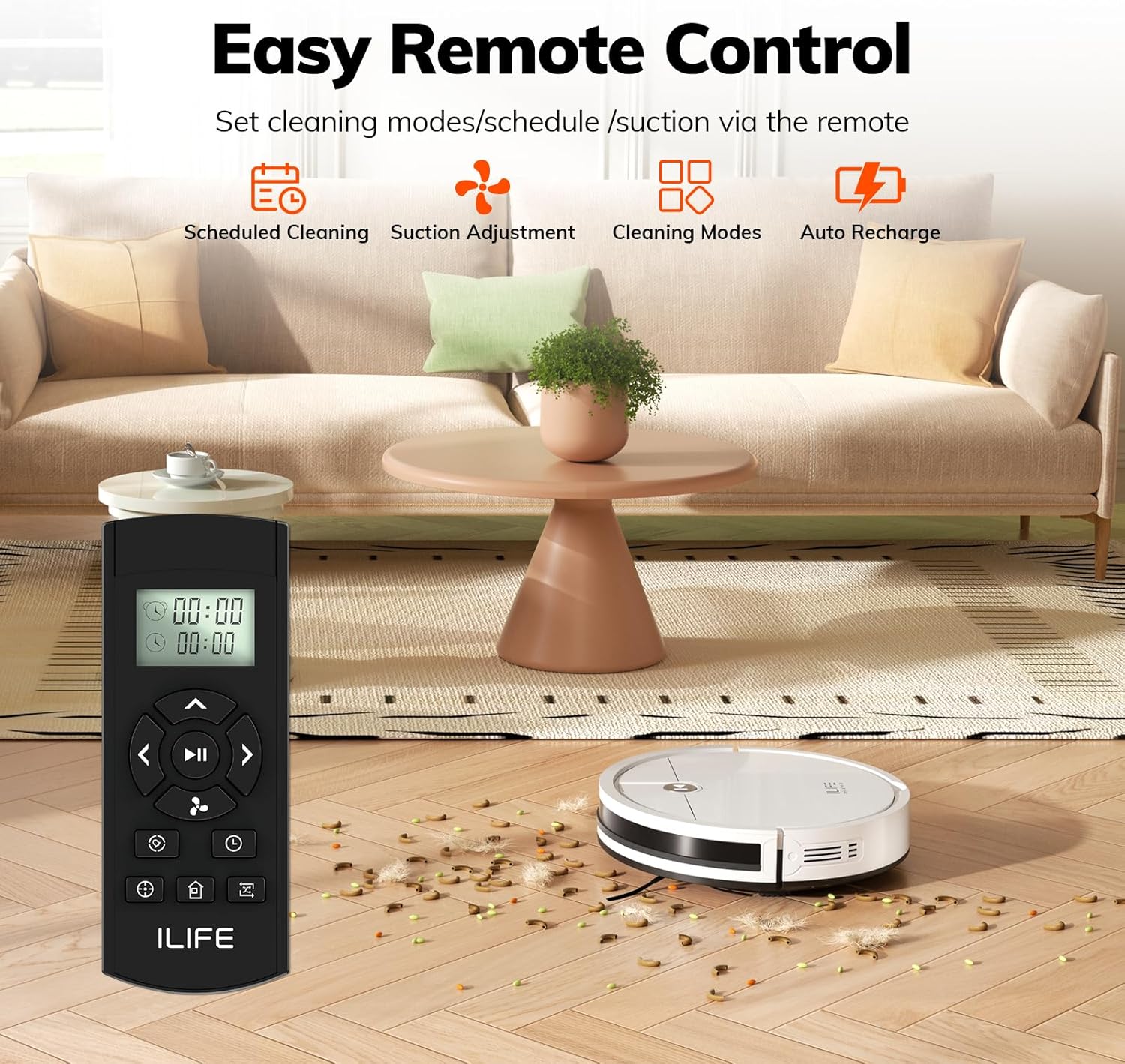
No app means no scheduling, no zone restrictions, no remote start from your phone, and no cleaning history. You press a physical button. That’s the interface. For some buyers — especially those who found app-paired vacuums finicky to configure — this is a feature, not a bug. For buyers who want to set a 2 a.m. cleaning schedule and never think about it again, this is a hard ceiling.
No map means you can’t tell it “skip the kitchen, just do the living room.” It will roam wherever it can reach. If you have open-plan living spaces, that’s fine. If you have a multi-room layout with specific zones you want excluded, a sub-$80 unit genuinely cannot deliver that.
Wirecutter (The New York Times), in its ongoing robot vacuum buyer’s guide, draws a consistent line between “maintenance cleaners” (daily light passes, simple navigation) and “primary cleaners” (full weekly cleans, room mapping, edge precision). Everything under $80 lives firmly in the maintenance cleaner category. Know that going in.
The Three Models Worth Considering — and What Owners Actually Report
eufy 11S MAX
ILIFE
$79.99
In stock on Amazon
Check price on AmazonThe eufy 11S MAX is the consensus pick for buyers prioritizing low noise and a low physical profile. At a manufacturer-rated 1,300 Pa of suction and a body height around 2.85 inches, it physically fits under more furniture than most competitors in this price tier — under chair bases, plant stands, and the gap beneath a raised dog bed where dust accumulates for months unnoticed.
The noise angle is meaningful. Owners consistently describe the unit running at a volume that doesn’t disturb pets or sleeping children — a contrast to the startling volume of upright vacuums. Multiple reviewers specifically mention that anxious dogs either ignored the eufy 11S MAX entirely or habituated to it far faster than expected. If pet anxiety around cleaning equipment has been a real-world friction point in your household, that pattern is worth weighting in your decision.
Several reviewers position this explicitly as a secondary unit — something they run daily in bedrooms while a smarter, louder robot handles the main living area. That’s an honest and useful framing. As a primary vacuum for a large home, its random-bounce navigation will frustrate you. As a quiet daily maintenance pass in a defined space, it earns its cost back quickly in time saved.
Wired’s coverage of robot vacuum performance across floor types notes that low-profile random-bounce units perform best on hard floors and very low-pile carpet (under approximately 6mm pile height). Medium-pile carpet reduces effective suction contact and slows the unit noticeably. (Source: Wired, “The Best Robot Vacuums for Every Floor Type,” product and floor-type analysis.)
ILIFE
$79.99
In stock on Amazon
Check price on AmazonLefant M201
ILIFE
$79.99
In stock on Amazon
Check price on AmazonThe Lefant M201 distinguishes itself on two axes: tangle-resistance for long hair, and first-run debris revelation.
On tangle-resistance: the Lefant uses a floating brush design with narrower intake geometry. Owners with long hair — human or pet — report it handles shedding without the wrap-and-jam failures common to traditional brush-roll designs. If you’ve ever had to cut a mat of compacted hair off a vacuum roller with scissors, reviewers with identical frustrations report the Lefant’s design sidesteps that specific failure mode. That’s a genuine quality-of-life difference for relevant households, not a marginal one.
On first-run surprise: multiple Lefant owners describe being startled by the debris volume collected on a first pass through a home that “didn’t look dirty.” TechCrunch’s reporting on the budget robot vacuum segment notes this is a consistent pattern across the category — hard floors that appear clean to the eye harbor significant fine-particle debris (skin cells, pet dander, tracked-in particulate) that a robot vacuum’s sustained low-pass suction captures better than infrequent manual vacuuming. The first run is often the most dramatic evidence of the unit’s value. (Source: TechCrunch, budget robot vacuum segment coverage.)
Lefant also offers basic Alexa integration on some configurations — worth confirming against the specific unit listing, as feature sets vary by SKU within the brand.
ILIFE
$79.99
In stock on Amazon
Check price on AmazonILIFE V2
ILIFE
$79.99
In stock on Amazon
Check price on AmazonThe ILIFE V2 is the entry point for buyers who want no moving brush parts at all. It uses suction-only intake with side brushes, which means zero brush-roll tangle risk by design. The trade-off is reduced carpet performance — without an agitating brush, the unit relies entirely on suction to lift debris from pile fibers. Published specifications and owner feedback both indicate this approach is adequate for hard floors and very light carpet but insufficient for anything with meaningful pile depth.
Reviewers lean heavily on “first robot vacuum” framing, and that positioning is honest. This is a low-risk proof-of-concept purchase — a way to test whether robot vacuum behavior fits your home layout and household habits before committing to a higher tier. At least one experienced multi-robot-vacuum owner in aggregated reviews notes they kept the ILIFE V2 upstairs where dirt load is lower, implying a deliberate deployment decision built around the unit’s capability limits. That’s the right mental model: understand where it’s strong, deploy it there, and don’t ask it to substitute for a mapped unit in a high-complexity environment.
ILIFE
$79.99
In stock on Amazon
Check price on AmazonBy the Numbers
| Model | Suction (rated) | Height | Brush Type | Smart Home |
|---|---|---|---|---|
| eufy 11S MAX | 1,300 Pa | ~2.85 in | Brush roll + side | None |
| Lefant M201 | 1,200–2,000 Pa (mode-dependent) | ~2.8 in | Floating brush | Alexa (select SKUs) |
| ILIFE V2 | Not published | ~3.0 in | Suction-only + side | None |
Pa = Pascals, a standard measure of suction pressure. Higher numbers indicate stronger pull. All figures are manufacturer-rated; real-world performance varies by surface type and debris load.
The Ceiling Problem: Where These Units Stop Working for You
This is the honest section every buyer needs to read before deciding.
Random-bounce navigation has a hard ceiling. Per IEEE Spectrum’s ongoing coverage of autonomous navigation architectures, the failure modes are consistent and predictable across the category:
- Multi-story homes: These units don’t know stairs exist. They will fall if not stopped by a cliff sensor — and while all three models include cliff sensors, sensor reliability at unusual stair-edge geometries is not guaranteed. Carrying the unit between floors manually is the only safe protocol.
- Scheduled room-specific cleaning: Not possible without mapping. You cannot instruct any of these units to clean the bedroom at 7 a.m. and leave the rest alone. The physical button is the only interface.
- High-debris rooms: Random-bounce units can saturate their dustbin faster than they cover the floor in high-load environments. After events that generate significant debris, multiple sequential runs may be needed.
- Complex furniture layouts: Dense furniture legs, floor cables, and narrow passages between furniture pieces increase the probability of the robot getting stuck mid-run. Owners of all three models consistently report needing to pick up floor cables and block off certain zones before running.
If any of those scenarios is your primary use case, the right answer is to step up to a mapped unit in the $150–$250 range — not to troubleshoot a fundamental capability gap in a unit that was never designed to solve it. Wirecutter (The New York Times) makes this distinction explicit in its navigation-tier analysis: mapped units and random-bounce units are not the same product at different price points; they are categorically different tools.
Frequently Asked Questions
Will these work on medium-pile carpet or only hard floors? Hard floors and low-pile carpet (roughly under 6mm pile height) are the reliable use case. Wired’s floor-type analysis and aggregated owner reviews both indicate medium-pile carpet reduces effectiveness noticeably — the eufy 11S MAX and Lefant M201 handle it better than the brush-free ILIFE V2, but none of the three are primary carpet cleaners for homes with significant pile depth.
How loud are they compared to a standard upright vacuum? Meaningfully quieter. Upright vacuums typically operate in the 70–80 dB range. Owners consistently describe these units running at a level comparable to a quiet conversation or a box fan — audible but not disruptive. The eufy 11S MAX draws the most consistent specific praise for low operating noise.
Can I run one of these on a second floor without carrying it up each time? You need a separate charging dock on each floor, or you carry the unit. These robots have no stair-climbing capability and no cross-floor awareness. If you want true second-floor coverage without the effort of carrying, purchasing a second dock is the practical solution. All three docks are compact and widely available.
Do any of these connect to Alexa or Google Home? The Lefant M201 offers Alexa compatibility on select configurations — verify against the specific SKU before purchasing. The eufy 11S MAX and ILIFE V2 have no Wi-Fi connectivity and no smart home integration by design.
How often do I need to empty the dustbin? For light maintenance cleaning — one run per day in an average household — most owners report emptying every 2–4 runs. Homes with pets or high-traffic shedding situations may need to empty after every run. First runs in a home not previously robot-vacuumed consistently produce fuller bins than subsequent maintenance passes.
Are replacement parts and brushes available? Eufy and ILIFE both have established parts ecosystems with side brushes, filters, and brush rolls available from multiple sources. Lefant’s parts availability is adequate but narrower — worth confirming before purchasing if long-term maintenance cost is a factor in your decision.
The Decision Rule
Here’s the if/then framework that cuts through the noise:
- If you want a quiet daily maintenance pass in a defined room — bedroom, home office, pet area — and you already own or plan to own a smarter primary robot → eufy 11S MAX is the right secondary unit.
- If you have long hair or significant pet shedding and want to avoid brush-roll maintenance entirely → Lefant M201 earns its price on that single axis alone.
- If you’ve never owned a robot vacuum and want to spend as little as possible to discover whether the category fits your life → ILIFE V2 is a low-regret proof-of-concept purchase.
- If you want room-by-room scheduling, smart home integration, or reliable multi-room coverage → none of these three are the right product. Step up to a mapped unit in the $150–$250 range and buy with confidence.
The sub-$80 robot vacuum is a real tool with a real use case. It isn’t a compromised version of a premium product — it’s a different product category entirely. Match it to what it’s actually good at, and it will earn its place in your home without drama.