A robot mower is exactly what it sounds like: a battery-powered machine that drives itself around your lawn on a schedule, cutting grass automatically without anyone holding a handle. On a small suburban lot, this is already a pleasant convenience. But once you cross the one-acre mark — roughly the size of a football field — you’re in a different category entirely. The machines get heavier, the navigation systems get more complex, the installation process gets more involved, and the gap between sticker price and what you’ll actually spend over three years widens dramatically. If you’re evaluating a robot mower for a property of one acre or more right now, this article will walk you through the real cost structure, explain when all-wheel drive (AWD) actually matters versus when it’s marketing, and give you a clear decision framework so you’re not caught off-guard after the purchase.
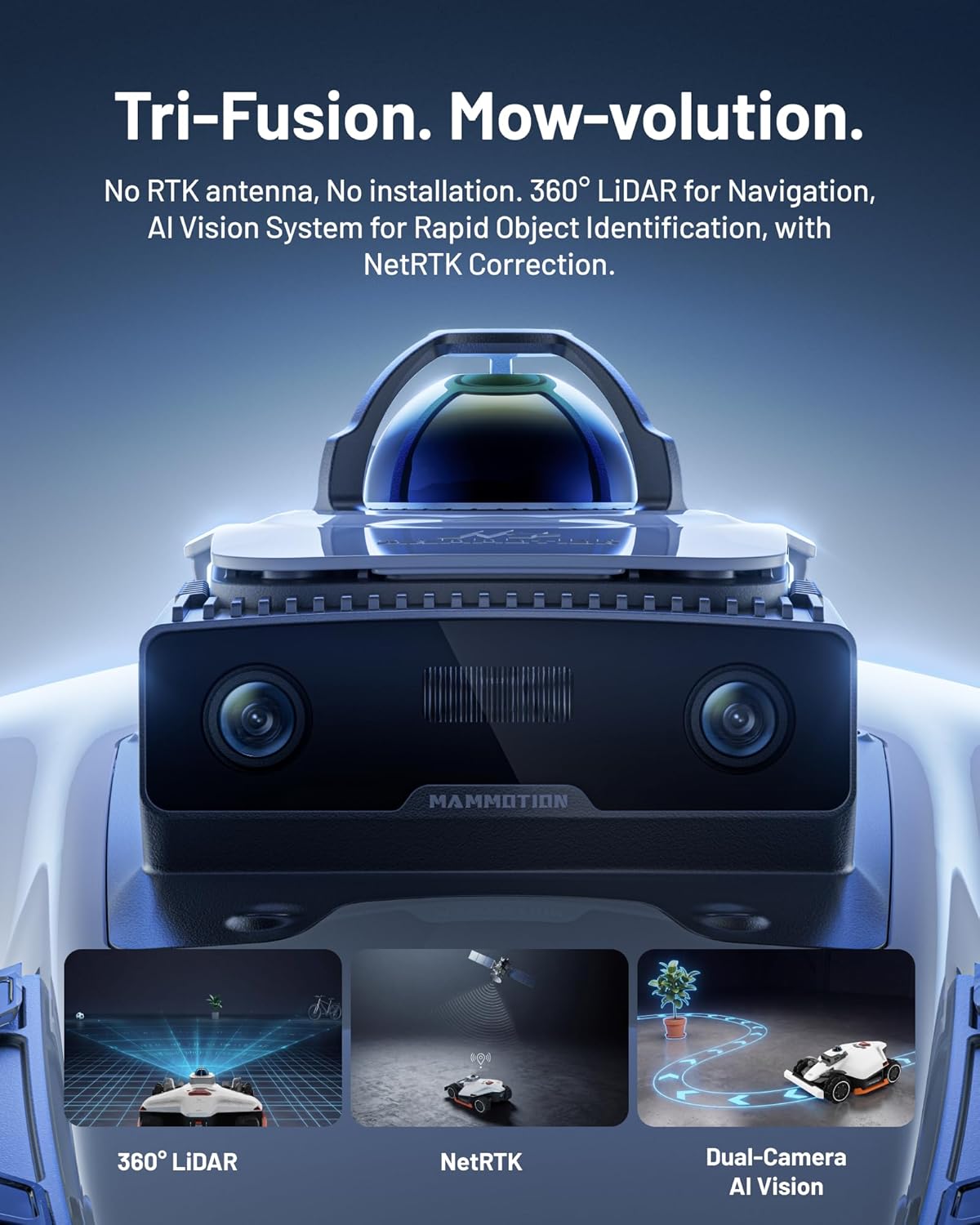
| EDITOR'S PICK[YARBO Robot Lawn Mower Pro with…](https://www.amazon.com/dp/B0FQTQ1M98?tag=greenflower20-20) | Mid-tier[Mammotion LUBA 3 AWD 5000H Robo…](https://www.amazon.com/dp/B0GKM8JZDF?tag=greenflower20-20) | Budget pick[Sunseeker X7 Wireless Robot Law…](https://www.amazon.com/dp/B0D31NMX9Q?tag=greenflower20-20) | |
|---|---|---|---|
| Area coverage | 6 acres | 1.25 acres | 0.75 acre |
| Cutting height | 0.8"–4.0" | — | up to 4" |
| Drive type | — | AWD | — |
| Positioning | AI Vision + RTK | LiDAR+NetRTK+AI Vision | Vision AI + RTK |
| Perimeter wire? | Wire-free | — | Wireless |
| Price | $4,999.00 | $2,899.00 | $1,884.00 |
| See on Amazon → | See on Amazon → | See on Amazon → |
Why Large-Yard Robot Mowers Are a Different Animal
Most robot mowers sold below $1,000 are designed for properties under half an acre with relatively flat terrain. When you move to acre-plus coverage, the engineering constraints multiply fast.
Battery capacity has to scale with area. A mower cutting one to two acres per charge needs a significantly larger battery pack — typically 10 Ah or more — and longer charge cycles. The Husqvarna Automower 450X, for example, is spec-rated to handle up to 1.25 acres (5,000 square meters) with a charge time of approximately 60 minutes and a cutting time of around 270 minutes per cycle. That ratio — charge time vs. cut time — is one of the most important specs to interrogate, and manufacturers don’t always make it easy to find.
Boundary management also changes at scale. Older perimeter-wire systems require you to bury or stake a physical wire around your entire property edge, which on a one-acre lot can mean 400 to 600 feet of wire routing — around obstacles, through gates, across driveways. More recent systems use RTK GPS (Real-Time Kinematic GPS, a precision satellite positioning technology accurate to within a few centimeters) to define virtual boundaries without any buried wire. IEEE Spectrum’s 2024 coverage of autonomous outdoor robots notes that RTK-based navigation is maturing quickly but still struggles with signal multipath issues near tree lines and dense structures — worth knowing if your acre includes a woodlot edge.
Finally, slope handling becomes genuinely consequential. A mower that slides or stalls on a 20-degree incline isn’t just ineffective — it’s a safety liability. This is the conversation where AWD enters the picture.
AWD: When It’s Necessary and When It’s Upsell
All-wheel drive in a robot mower means all four wheels receive independent motor torque, rather than the rear wheels doing all the driving work. On paper, this sounds universally better. In practice, it matters on specific terrain and less on others.
When AWD is genuinely necessary:
- Slopes above 35% grade (roughly 19 degrees). Most single-drive robot mowers are rated to 35–45% slopes in ideal conditions; wet grass, heavy clay soil, or thatch significantly reduces effective traction below those rated limits. Owners of properties with rolling hills consistently report that non-AWD machines lose traction and retreat to flatter zones, leaving high spots uncut.
- Mixed terrain with soft patches. If your acre includes a low-lying boggy section, areas with heavy moss, or transitions from packed soil to loose fill, AWD provides meaningful torque distribution to prevent wheel spin.
- Properties with multiple steep access slopes between flat sections. The mower has to navigate between zones, and a single stall in transit defeats the automation value.
When AWD is likely overkill:
- Flat or gently rolling properties under 25% slope. The Mammotion LUBA 2 AWD has drawn strong owner community interest for its GPS-based navigation and AWD system, but Mammotion’s own published specs rate the non-AWD LUBA 2 variant at up to 40% slopes — adequate for the majority of residential acre-plus lots. Paying the AWD premium on flat ground is real money with no performance dividend.
- Properties where the added machine weight becomes a problem. AWD systems add 2–4 kg to the mower’s frame. On soft lawns, heavier machines create more wheel rut risk in wet conditions.
Wirecutter’s 2025 robot mower coverage draws the same distinction, noting that AWD is a meaningful differentiator primarily on “hilly or multi-terrain properties” and recommending prospective buyers map their steepest grade before spec-shopping.
The Real Numbers: Total Cost of Ownership Over Three Years
Here’s where most buying guides stop too early. The sticker price is the smallest lever in this decision.
By the numbers — illustrative TCO, 1.25-acre property, 3-year horizon:
| Cost Category | Perimeter-Wire System | RTK GPS System |
|---|---|---|
| Hardware (mower + base station) | $2,800–$4,200 | $3,500–$5,500 |
| Professional installation | $400–$900 | $150–$350 |
| Blade replacements (3 yrs) | $90–$180 | $90–$180 |
| Connectivity/app subscription | $0–$120/yr | $0–$180/yr |
| Battery replacement (yr 3–4) | $200–$400 | $200–$400 |
| 3-year total (mid estimate) | ~$4,300 | ~$5,200 |
Sources: Husqvarna Automower pricing and accessory documentation; Mammotion LUBA 2 product pages; Worx Landroid owner documentation; Robotics and Automation News market pricing analysis, 2025.
A few line items in that table deserve unpacking.
Professional installation is the cost most buyers underestimate. Perimeter-wire systems sound DIY-able, but a one-acre layout with multiple obstacle exclusion zones and gate pass-throughs realistically takes 6–10 hours of careful routing, staking, and calibration. Professionals who specialize in robot mower installation typically charge $60–$90/hour in 2026. Get this wrong — a wire nick, a poorly grounded connection — and your mower will throw fault codes for months.
RTK GPS systems skip the wire burial but require clear satellite sky view for the base station and a calibration walk of the entire boundary. Setup is faster and usually DIY-accessible, but the base station needs a permanent outdoor power source, which sometimes requires an electrician if your property doesn’t have a convenient exterior outlet at the right location.
Blade replacements are a recurring cost almost nobody prices in. Robot mowers use small replaceable blade segments — typically three to nine small razor-type blades mounted on a central disc. They’re cheap per unit ($15–$40 for a set) but need replacement every 1–3 months depending on debris load, stone exposure, and lawn conditions. On a one-acre property with normal stick and stone debris, budget toward the three-replacement-per-year end of the range.
Subscription fees have entered the robot mower space in a meaningful way since 2024. Some manufacturers gate cellular connectivity, remote diagnostics, and advanced scheduling behind annual subscriptions. Husqvarna’s Automower Connect service, the Mammotion app’s premium tier, and Worx’s KRESS Connect all have tiered feature access. Before you purchase, specifically ask: what features does the mower lose if I decline or cancel the subscription? A mower that won’t receive theft alerts or remote stop commands without a $120/year plan is a different value proposition than one where connectivity is permanently included.
Battery longevity follows the same degradation curve as other lithium-ion devices. Across aggregated owner reports and manufacturer guidance, most large-yard robot mower batteries reach 70–80% capacity after 400–500 charge cycles — roughly three to four years of daily summer use. Replacement packs run $200–$400 depending on platform. This cost is almost never mentioned in a product listing and is almost always absent from competing brand comparison articles.
Compatibility and Ecosystem Lock-In: The Hidden Integration Risk
If you’re evaluating multiple brands side by side, one factor that rarely appears in spec comparison tables is ecosystem lock-in.
Robot mowers from Husqvarna, Mammotion, Worx, and Robomow each use proprietary charging stations, proprietary blade systems, and proprietary app ecosystems. There is no cross-brand blade standard. There is no universal installation cable. This means that if you switch platforms in year three — because a competitor releases a model with better slope handling, or your current brand discontinues support — you’re not salvaging any hardware investment except potentially the perimeter wire (and only if your new platform also uses wire-based guidance at the same frequency).
Robomow’s RS lineup and the Husqvarna 400-series are particularly siloed — even within their own brands, blade sizes and dock hardware aren’t always interchangeable between model generations. Operators reviewing long-run ownership on Robomow community forums note that mid-generation platform changes can leave owners with charging stations that won’t accept firmware updates for newer docks, effectively forcing a full hardware refresh.
If avoiding lock-in matters to your operation — say you manage multiple properties and want a single service platform — Mammotion’s LUBA 2 series has drawn attention for relatively open API access and multi-unit management, though the Robotics and Automation News 2025 market analysis notes that “enterprise multi-mower management dashboards remain an emerging capability across most residential-grade platforms.”
If X, Then Y: The Decision Framework
You’ve read the tradeoffs. Here’s how to apply them.
If your property is flat to gently rolling (under 25% slope) and you primarily want to eliminate weekly mowing labor: A perimeter-wire system in the $2,500–$3,500 range — Husqvarna Automower 430X, Worx Landroid L1000 — is the cost-efficient pick. Plan for professional installation, and budget $150/year for consumables and connectivity. AWD is not worth the premium here.
If your property has meaningful slopes (25–40%+) or mixed soft-terrain sections: Move to an AWD or high-torque platform. Evaluate the Mammotion LUBA 2 AWD or Husqvarna Automower 450X at their published slope ratings against your actual measured grade. Have someone walk the property with a smartphone inclinometer app before you finalize; marketing slope numbers assume dry, healthy turf.
If you’re managing multiple properties or want to avoid buried wire infrastructure: RTK GPS systems are worth the $700–$1,200 premium over comparable wire-based units. The setup flexibility and the avoidance of wire maintenance over a three-year horizon typically offset the price gap. Just validate your satellite sky view before committing — a tree canopy that blocks 40% of the sky can degrade RTK accuracy enough to create boundary drift problems, as noted in IEEE Spectrum’s 2024 analysis of GNSS precision for outdoor autonomous systems.
If total three-year cost is your primary constraint: Build the TCO table above for each finalist model using the actual published blade prices, subscription tiers, and battery replacement costs from each manufacturer’s accessory catalog. The machine with the lower sticker price is frequently not the machine with the lower three-year cost. That arithmetic is almost always worth doing before you sign anything.
The robot mower market for large properties is genuinely competitive and improving fast — Robotics and Automation News projects the segment will continue double-digit unit growth through 2028. But the buying complexity hasn’t simplified at the same pace. Do the full cost math, measure your steepest slope, and interrogate the subscription terms before you commit. The mower that handles your acre reliably for four years at predictable cost is worth more than the one with the most impressive spec sheet.