If you’ve just opened a LEGO Mindstorms EV3 box — or you’re buying one for a child or classroom — here’s the honest truth: the kit itself is remarkably complete hardware, but the included instructions are basically a starter recipe, not a cooking education. The EV3 (short for Evolution 3, LEGO’s third-generation programmable robotics platform) gives you motors, sensors, and a central “brain” called the Intelligent Brick, all of which snap together using standard LEGO Technic connectors. What it doesn’t give you is a real path from “I built the thing on the box” to “I understand what I just built.” That gap is where books and third-party resources either earn their price or don’t. This guide is for anyone who’s past the unboxing phase — whether you’re a parent coaching a homeschooler, a competition team mentor, or a self-directed builder who’s hit the ceiling of the bundled software tutorial.
We’ll walk through which resources actually close that gap, name the tradeoffs clearly, and end with a decision framework you can use today.
Why the Box Instructions Leave You Stranded
The EV3 retail set (officially the LEGO Mindstorms EV3 31313) ships with a getting-started guide and access to the EV3 programming software — a visual, block-based environment where you drag and drop command blocks to program your robot. That’s fine for an afternoon. The problem is the instructions treat the hardware as the point. They show you what to build, not why it works, which means as soon as you want to do anything outside those prescribed builds, you’re on your own.
Reviewers across aggregated purchasing patterns consistently describe the same arc: enthusiastic first build, satisfying second build, total confusion on the third. The included curriculum doesn’t explain sensor calibration, loop logic, or data wiring — the connectors between program blocks that let you make decisions based on live sensor input. That’s not a failure of the hardware. It’s a documentation gap, and it’s exactly what the best third-party books address.
By the numbers:
| Resource | Best for | Learning curve |
|---|---|---|
| Included instructions | First 1–2 builds | Very low |
| The EV3 Discovery Book (Valk) | Complete beginners through intermediate | Low → medium |
| The Art of EV3 Programming (Griffin) | FLL teams, intermediate+ builders | Medium |
| LEGO Education curriculum PDFs | Educational/classroom use | Low (structured) |
The Discovery Book: Why It Keeps Coming Up as the Benchmark
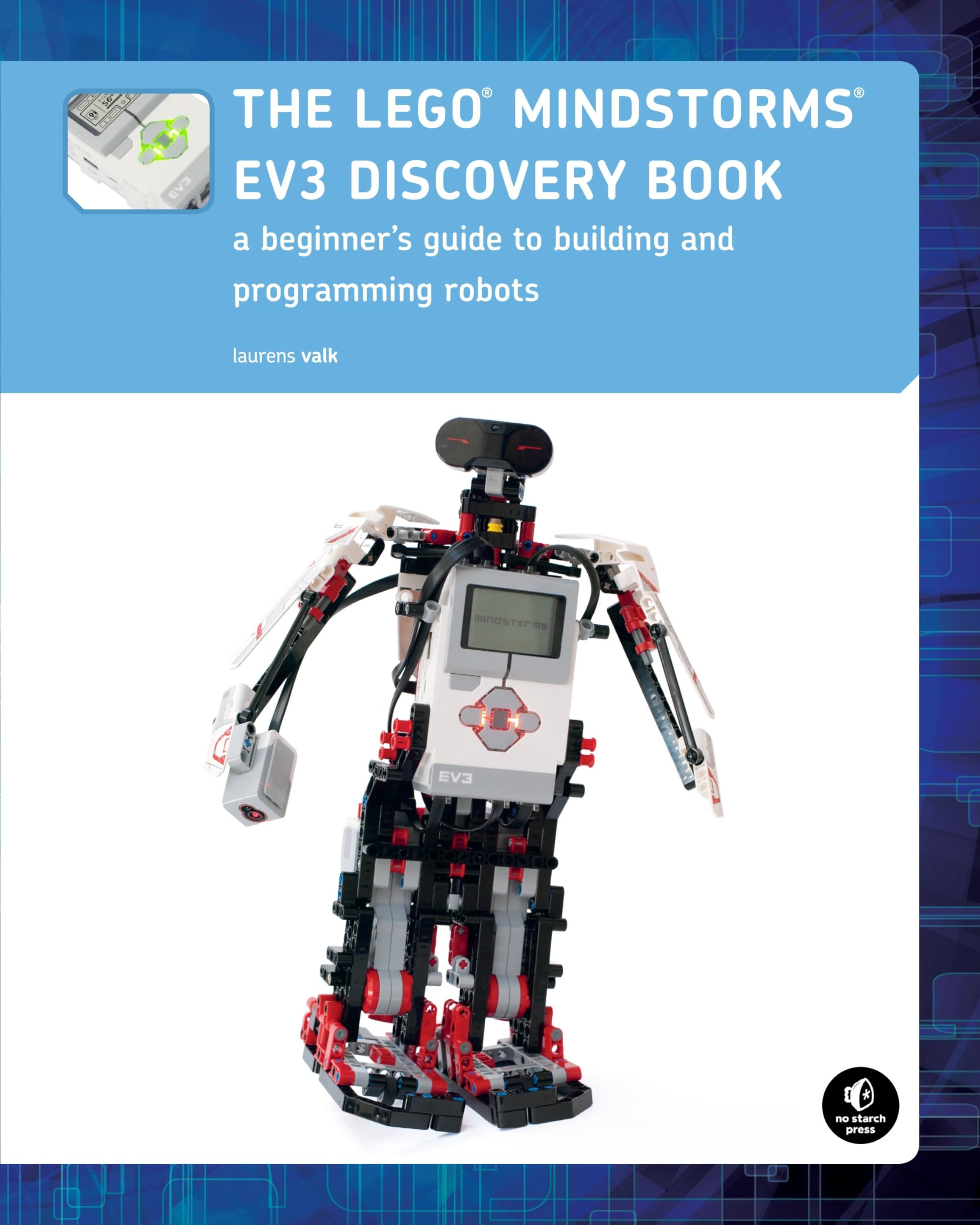
Laurens Valk’s The LEGO Mindstorms EV3 Discovery Book, published by No Starch Press, is the resource that reviewers across the buyer community keep naming when asked what actually worked. The pattern in aggregated reviews is unusually consistent: readers who tried multiple books, tutorials, and online courses tend to return to this one as the foundation they wished they’d started with.
What makes it credible beyond the praise? One frequently cited signal is that one of Valk’s models from the book was adopted into LEGO’s own official downloadable instructions — a detail buyers in multiple reviews treat as meaningful external validation. When LEGO’s own documentation team incorporates a third-party author’s work, it’s reasonable to interpret that as a quality signal, even accounting for the fact that LEGO’s official curriculum is now managed by a different division.
The book’s structure is the real differentiator. It doesn’t assume you know what a sensor threshold is or why a loop needs an exit condition. It builds the vocabulary from scratch, then layers programming concepts on top of that vocabulary in a sequence that actually tracks with how novice builders develop intuition. A parent homeschooling an 11-year-old with no personal robotics background described the book as essential precisely because they weren’t the expert in the room — the book had to do the teaching for both of them. That’s a significant use case to satisfy.
What it covers that the box doesn’t:
- Data wiring between blocks (how sensors feed decisions)
- Calibration routines for the color and ultrasonic sensors
- Multi-motor coordination
- Structured build sequences with design rationale explained
Tradeoff to name explicitly: The Discovery Book is print-oriented and sequential. If your learner does better with video and nonlinear exploration, the book’s density can feel like homework. It’s a read-and-build resource, not a reference you flip through.
The Art of EV3 Programming: The FLL Team’s Secret Weapon
Terry Griffin’s The Art of EV3 Programming, also from No Starch Press and notable for being printed in full color, occupies a different niche. Where the Discovery Book earns its reputation as the entry-level workhorse, the Art of EV3 Programming gets cited specifically in the context of competitive robotics — particularly FIRST LEGO League (FLL) teams, where building reliable autonomous behavior under competition pressure is the actual goal.
The FIRST LEGO League Challenge Resource Guide (published by firstlegoleague.org) outlines the autonomous task requirements that FLL robots must meet, and that context matters: competition teams need to go deeper than “move forward and detect a wall.” They need data logging, precise turning algorithms, and the ability to save sensor data to a file between missions. Reviewers of Griffin’s book — including experienced builders who considered themselves competent with the platform — consistently report being surprised by coverage of features like data file saving, which isn’t documented anywhere in the standard LEGO materials.
That’s a meaningful scope distinction. If your context is an FLL team preparing for a regional tournament, or any builder who needs autonomous robots to make complex sequential decisions, the Art of EV3 Programming fills a gap that the Discovery Book and the included software tutorials simply don’t address.
If X, then Y — the decision fork:
- If you’re a beginner or teaching a beginner: start with the Valk Discovery Book, full stop.
- If you’re an FLL team mentor or have outgrown the Discovery Book: the Griffin book is the next investment.
- If you’re both: buy both. The total investment is modest relative to the hardware cost, and the overlap is minimal.
The Expansion Set and the Standalone Brick: Where Buyers Misread the Listings
Two EV3 products generate consistent buyer confusion, and that confusion costs money — often without the buyer realizing it until a package arrives.
The EV3 Expansion Set (45560) is a supplemental piece pack, not a standalone kit. Reviews describe it accurately as hardware for builders who’ve hit the structural ceiling of the core set — you’ve run out of the right beams, frames, or connectors to build what you’re picturing. Expansion set reviews are positive, but they consistently note the audience: this is for someone who already has the core set and wants more physical vocabulary. If you’re a first-time buyer, this set will arrive and feel oddly incomplete, because it is — by design.
The EV3 Intelligent Brick sold separately generates the most pointed warnings in aggregated reviewer feedback. The pattern is notable for its repetition: buyer after buyer who purchased the standalone brick expecting a functional starter kit describes opening a box that contains only the programmable brick itself — no motors, no sensors, no power pack, no connecting cables, no instructions. The standalone brick is a replacement part or an expansion component for builders who need a second programmable brain for a complex multi-robot setup. Bought as an introduction to EV3, it’s a frustrating and expensive mistake.
The editorial takeaway from Make: Magazine’s coverage of Mindstorms classroom use (make.co) aligns with this: the EV3 ecosystem is modular in ways that are powerful for experienced buyers and genuinely confusing for new ones. Read the listing contents carefully. If “motors,” “sensors,” and “cables” aren’t on the contents list, they’re not in the box.
What Happens Now That EV3 Is Discontinued
LEGO officially retired the Mindstorms EV3 line at the end of 2022, and by 2026 the ecosystem picture has stabilized into something manageable but worth understanding before you commit.
The software situation: The official EV3 Lab software (the drag-and-drop programming environment) still functions on current operating systems for most users, though LEGO has ceased active development. The open-source community has filled part of this gap: ev3dev, a Debian-based Linux distribution that runs directly on the EV3 brick, remains actively maintained as of this writing and opens the platform to Python and MicroPython programming — which is actually a learning upgrade path, not a downgrade. The ev3dev project documentation (available through the ev3dev GitHub organization) is thorough and community-supported.
Parts and hardware: EV3 hardware is still widely available through secondary markets and remaining retail inventory. The core sensor and motor types haven’t changed, and because the EV3 uses standard Technic connectors, third-party sensors from manufacturers like HiTechnic and Mindsensors remain compatible.
Books: Both the Valk and Griffin titles remain in print and relevant. The programming concepts they teach translate directly to the platform regardless of which software environment you use, including the newer SPIKE Prime platform if a learner eventually migrates.
Bottom line on discontinuation: For a homeschooler, maker, or competition team committing to EV3 in 2026, the discontinued status is a price and availability risk, not a functionality risk. Budget for the hardware now; the learning resources remain sound.
Frequently Asked Questions
Is the LEGO Mindstorms EV3 Discovery Book suitable for children who have never programmed before? Yes — it’s arguably the best-suited resource for exactly that audience. The book builds programming concepts from scratch without assuming prior exposure to code, loops, or sensor logic. Reviewers who used it with children in the 10–14 range consistently describe it as readable without adult translation.
Do I need to buy a book to learn EV3 programming, or are the included instructions enough? The included materials are enough to build the pre-designed models. They’re not enough to understand why those models work or to design your own robots with any reliability. If your goal is functional programming literacy — especially for competition or independent projects — a structured book makes a material difference.
What is the difference between the EV3 retail set and the EV3 educational core set for books and resources? LEGO Education’s core set (45544) and the consumer retail set (31313) share most of the same hardware, but the educational set includes different sensors (notably a gyroscope) and comes with curriculum materials designed for classroom instruction. Per LEGO Education’s own comparison documentation, the educational set targets structured classroom delivery; the retail set targets individual purchase. Both work with the Valk and Griffin books, though some specific builds may reference one set’s components over the other — check before you buy.
Can a parent with no robotics background teach EV3 using these books? Based on parent reviewer accounts, yes — with the Discovery Book specifically. The book is designed to carry both the learner and the guide simultaneously, which is exactly what a non-expert parent needs. It explains the reasoning behind every step rather than just the steps themselves.
Is the EV3 Intelligent Brick sold separately worth buying if I already have a full set? Only if you have a specific use case that requires a second programmable controller — such as a complex competition robot or a multi-robot classroom setup. For a typical builder with one full kit, the standalone brick adds nothing practical and brings none of the accessories required to use it independently.
What happens to EV3 software support and parts now that LEGO has discontinued the product? The official software still functions but won’t receive updates. The ev3dev open-source community provides a maintained alternative that supports Python programming. Hardware parts remain available through secondary markets, and the core sensor ecosystem is stable. For buyers entering in 2026, the functional lifespan of the platform is real but finite — factor that into a multi-year learning program.