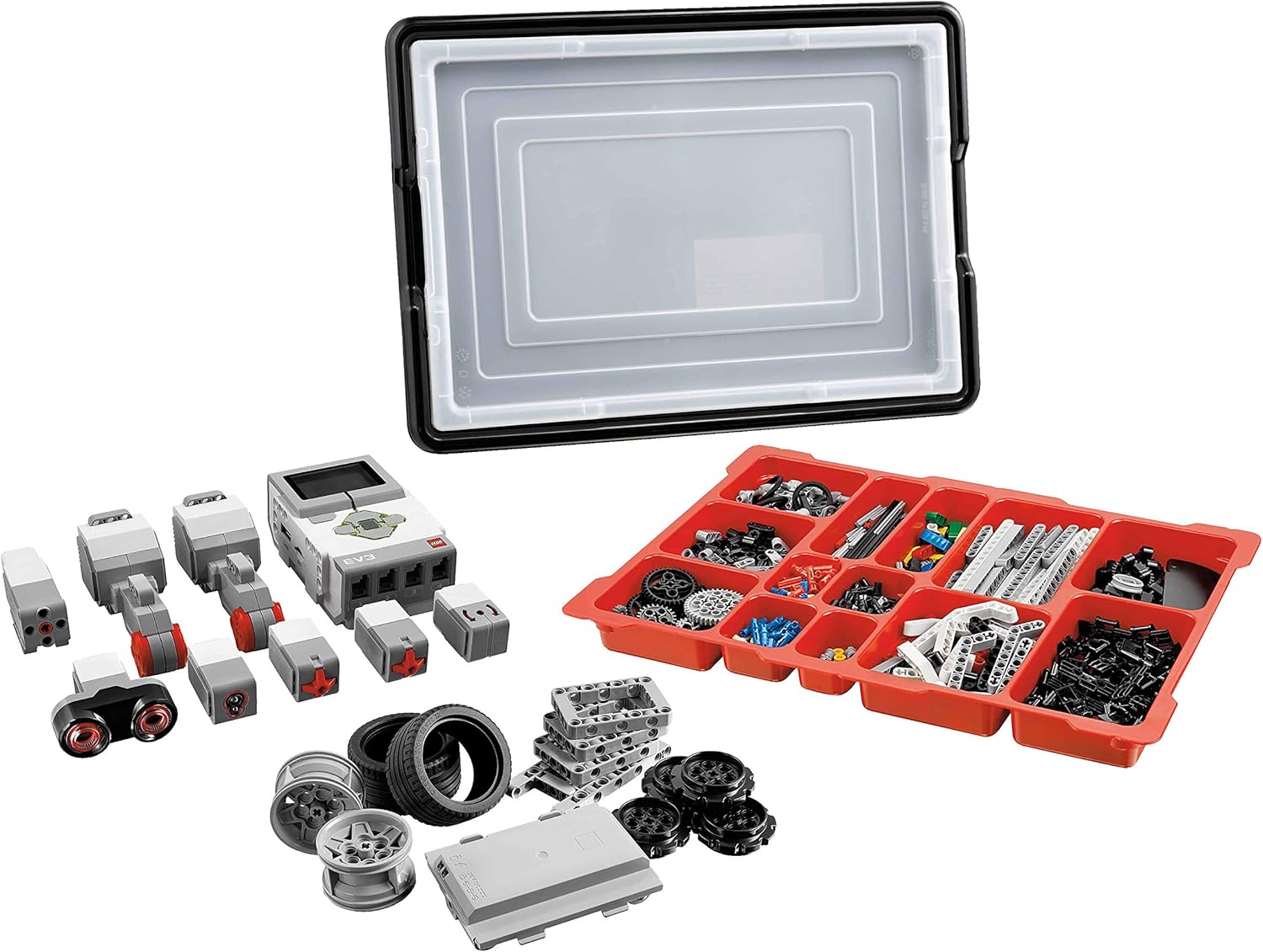
LEGO Mindstorms EV3 is a programmable robotics kit — essentially a plastic brick-based construction system paired with motors, sensors, and a small computer called the “Intelligent Brick” — that’s been a classroom and hobbyist staple since 2013. LEGO discontinued the EV3 line in 2022, which means no more retail production, but the used market and remaining new-old-stock (NOS) units are still very much in circulation. If you’re an educator deciding whether to equip a classroom, a competition coach building out a FIRST LEGO League (FLL) team, or a maker evaluating a low-cost cobot-style arm project, the EV3 still comes up in shortlists — and the discontinuation hasn’t made the buying decision simpler. It’s made it more complicated.
This guide focuses on the three questions that actually determine whether an EV3 purchase makes sense in 2025: what the platform can physically carry (payload), what the Python software landscape looks like right now, and whether the current market price is defensible when alternatives exist. We’ll name the tradeoffs directly and give you a clear decision rule at the end.
What the EV3 Can Actually Move: Payload Reality vs. Marketing Language
LEGO’s own documentation lists the Medium Motor at a stall torque of roughly 8 N·cm and the Large Motor at approximately 40 N·cm — these are the two motor options included in the flagship 45544 Education Core Set. Torque (rotational force) matters because it sets a ceiling on how much weight a robot arm, gripper, or conveyor mechanism can actually lift or push before the motor stalls or the gearbox strips.
In practical terms, owners and competition coaches consistently report that a single Large Motor driving a simple arm can manage payloads in the 200–400 gram range before you start seeing gear slip and inconsistent positioning. That aligns with what FIRST LEGO League-oriented communities have documented over years of competition builds: anything approaching 500 grams at a 10 cm moment arm is risky territory without geardown modifications using additional LEGO Technic gear reductions.
By the numbers:
| Motor | Stall torque (rated) | Practical arm payload (reported) | Speed (no load) |
|---|---|---|---|
| EV3 Large Motor | ~40 N·cm | 200–400 g at short arm | ~170 RPM |
| EV3 Medium Motor | ~8 N·cm | 50–150 g at short arm | ~250 RPM |
Why does this matter to you? If your use case involves sorting small objects (the classic FLL competition scenario), feeding lightweight components into a fixture, or demonstrating pick-and-place concepts for educational purposes, EV3’s payload envelope is workable. If you’re evaluating it as a stand-in for a cobot during early-stage process design — thinking you’ll validate gripper geometry before committing to a UR3e purchase — you need to know the EV3’s maximum reach-payload combination is roughly 10× below even the smallest collaborative robot arms. It’s useful for concept-level mockups, not force or torque validation.
The brick-built frame itself is also a constraint. LEGO’s beam-and-axle system is rigid enough for light-duty tasks, but deflects measurably under sustained lateral loads, which reviewers across Hackaday’s EV3 project coverage consistently flag when builds exceed 300 mm of arm extension. Plan your geometry accordingly.
Python Compatibility in 2026: What Works, What’s Abandoned, and What’s Been Revived
This is where the EV3 story gets genuinely complicated, and where a lot of buyers get burned.
LEGO’s official programming environment for EV3 was the block-based EV3 Classroom app (and its predecessor, the EV3 Programming software). Both are alive but in maintenance mode — LEGO’s official support documentation makes clear that active development has stopped alongside the hardware discontinuation.
The more interesting Python path runs through ev3dev, an open-source Debian Linux image that boots from a microSD card inserted into the EV3 Intelligent Brick, effectively replacing the stock firmware. The ev3dev project lets you write MicroPython (and standard Python 3, depending on the library) directly on the brick. The ev3dev.org documentation confirms the project is community-maintained and not LEGO-affiliated. The practical reality: ev3dev is functional but frozen. The last major release predates 2023, and community activity on the project’s GitHub has slowed substantially.
For FLL competition use specifically, FIRST’s approved parts and documentation require teams to use the official EV3 firmware and EV3 Classroom app — ev3dev is not an approved competition environment in most FIRST regional programs as of the 2025–2026 season. That’s a hard constraint if you’re a competition coach.
For classroom instruction or independent projects, ev3dev remains a legitimate Python on-ramp. The IEEE Spectrum coverage of post-Mindstorms robotics curriculum choices notes that educators who stayed with EV3 hardware past 2023 largely did so because ev3dev let them teach real Python syntax rather than block-based logic — a meaningful pedagogical advantage for middle and high school programs bridging toward data science or engineering coursework.
The caveat: ev3dev requires a microSD card (Class 10 or better, 4GB minimum per the project documentation), some comfort with Linux boot environments, and patience with library documentation that hasn’t been updated recently. Owners consistently report that the initial setup works reliably on Windows 10/11 and macOS Ventura forward, but that Bluetooth connectivity for wireless programming can be temperamental depending on USB Bluetooth dongle model.
The cleaner Python path for new buyers is actually not the EV3 at all — it’s SPIKE Prime, LEGO Education’s current (non-discontinued) platform, which runs MicroPython natively in its official app. But SPIKE Prime carries its own price premium and a different sensor/motor ecosystem, so it’s not a drop-in replacement if you’re inheriting EV3 curriculum or hardware.
Is the Current Market Price Still Justified?
This is the TCO (total cost of ownership) question, and the answer has shifted meaningfully since 2022.
The 45544 Education Core Set listed at approximately $379–$420 USD when LEGO was actively producing it. As of mid-2026, NOS units from education distributors are appearing in the $350–$450 range — a narrow discount that doesn’t reflect the platform’s discontinued status as aggressively as you might expect. Used complete sets in good condition (all sensors present, brick functioning, battery not swollen) are trading on education surplus marketplaces in the $180–$280 range. Incomplete or sensor-missing sets are genuinely cheap but often not worth the frustration of sourcing specific sensors from a discontinued product line.
Here’s the hidden cost structure that the sticker price doesn’t show you:
- Rechargeable battery pack: The EV3 can run on 6× AA batteries, but serious classroom use requires the rechargeable lithium pack (45501), which was selling at roughly $60–$80 from remaining stock. Without it, battery costs add up fast in a classroom with 10+ kits.
- Storage and organizational trays: LEGO Education’s own sorting trays are useful but not included. Third-party options are available; owners in long-run classroom reviews consistently report that unsorted EV3 bins destroy prep time.
- Software support horizon: Budget zero for paid software — ev3dev is free, EV3 Classroom app is free. But budget time (real cost) for keeping firmware and connectivity working as operating systems update. One reviewer roundup on Hackaday notes that the 2024 macOS Sonoma release broke the EV3 Classroom app’s USB driver for several months before a community fix emerged.
- Curriculum materials: LEGO Education’s official curriculum was sold separately and some of it is now behind a legacy access wall. Third-party curriculum (Carnegie Mellon’s Robotics Academy, for example) remains available and is often preferred by experienced educators anyway.
The honest comparison frame: If your use case is FLL competition prep and you’re buying in 2025–2026, the EV3 at $350+ NOS is a hard sell against the SPIKE Prime platform, which is FIRST’s actively supported competition hardware and runs native Python. The Robot Report’s coverage of the post-Mindstorms classroom robotics market notes that FIRST shifted FLL to SPIKE Prime in 2024, which means EV3 is now a legacy platform for competition purposes — functional for practice, not eligible for current-season competition builds in most regions.
If your use case is a STEM classroom that doesn’t do competition prep, wants Python instruction, and can find complete used sets in the $200–$250 range, the EV3 via ev3dev is still a legitimate choice. The sensor ecosystem (color, touch, ultrasonic, gyro all included in the Core Set) is genuinely good for teaching sensor fusion concepts, and the mechanical system’s buildability is unmatched at any price point.
If you’re a maker evaluating EV3 for a light-duty automation concept prototype — a small conveyor, a sorting mechanism, a camera-triggered actuator — the ev3dev + Python combination is usable, the payload limits are manageable for many tasks, and a used set at $200–$250 represents acceptable proof-of-concept spend. Just don’t expect software community support if you run into an obscure library bug.
The Decision Rule
Here’s where we land after running the numbers and the use-case matrix:
If you’re coaching FLL in the 2025–2026 season or beyond: Don’t buy EV3 new. Redirect budget to SPIKE Prime. EV3 is off the competition-legal list for current FIRST seasons in most regions, and you’ll spend that saved TCO on platform parity.
If you’re equipping a classroom for Python-focused robotics instruction and your budget ceiling is $250 per kit: A complete used EV3 set with the rechargeable battery is defensible. Run ev3dev, budget 3–4 hours of setup time per kit, and use CMU Robotics Academy’s curriculum materials. Accept that you’re building on a frozen platform.
If you’re a maker doing lightweight process mockups: Used EV3 at $200–$250 is fine for concept validation. Keep payload expectations under 300 grams, use ev3dev for Python control, and treat this as throwaway spend before you commit to real automation hardware.
If anyone is quoting you NOS at $400+ for a discontinued platform: That price requires real justification — either you have an immediate FLL legacy-season use case or you’ve found no usable used units. At $400, you’re within range of platforms with active development, current competition eligibility, and a software ecosystem that will still be maintained in three years.
The EV3 is not dead — it’s just done growing. Whether that’s acceptable depends entirely on what you’re building and for how long you need the platform to carry you forward. Know your horizon before you buy.