If you’ve been watching the robot vacuum market long enough to know the difference between a drag-pad mop and a spinning disc mop, you’re already past the “is this thing even worth it” phase. But the $600-and-up tier introduces a new set of questions — questions about whether the spec bumps on flagship models translate into daily-life improvements, or whether you’re mostly paying for marketing headroom. A robot vacuum-mop combo is exactly what it sounds like: a single robot that vacuums your floors on one pass and scrubs them with a wet mop attachment on the same run, ideally without soaking your area rugs. The promise at the premium tier is that these machines get smart enough to handle complex homes — multiple rooms, different floor types, structured cleaning schedules — without constant babysitting. This article is built around a concrete comparison: the Roborock Qrevo S5V (the current flagship in Roborock’s combo line) against the Roborock Q7 M5+ (its well-reviewed mid-tier sibling), with the Ecovacs Goat as a reference point for buyers evaluating across brands. We’ll name the tradeoffs, show the math where it’s useful, and give you a clear decision rule at the end.
What You’re Actually Paying For Above $600
The jump from a $300–$400 robot vacuum to a $600-plus model isn’t linear. You’re not just buying more suction — you’re buying a fundamentally different approach to floor management.
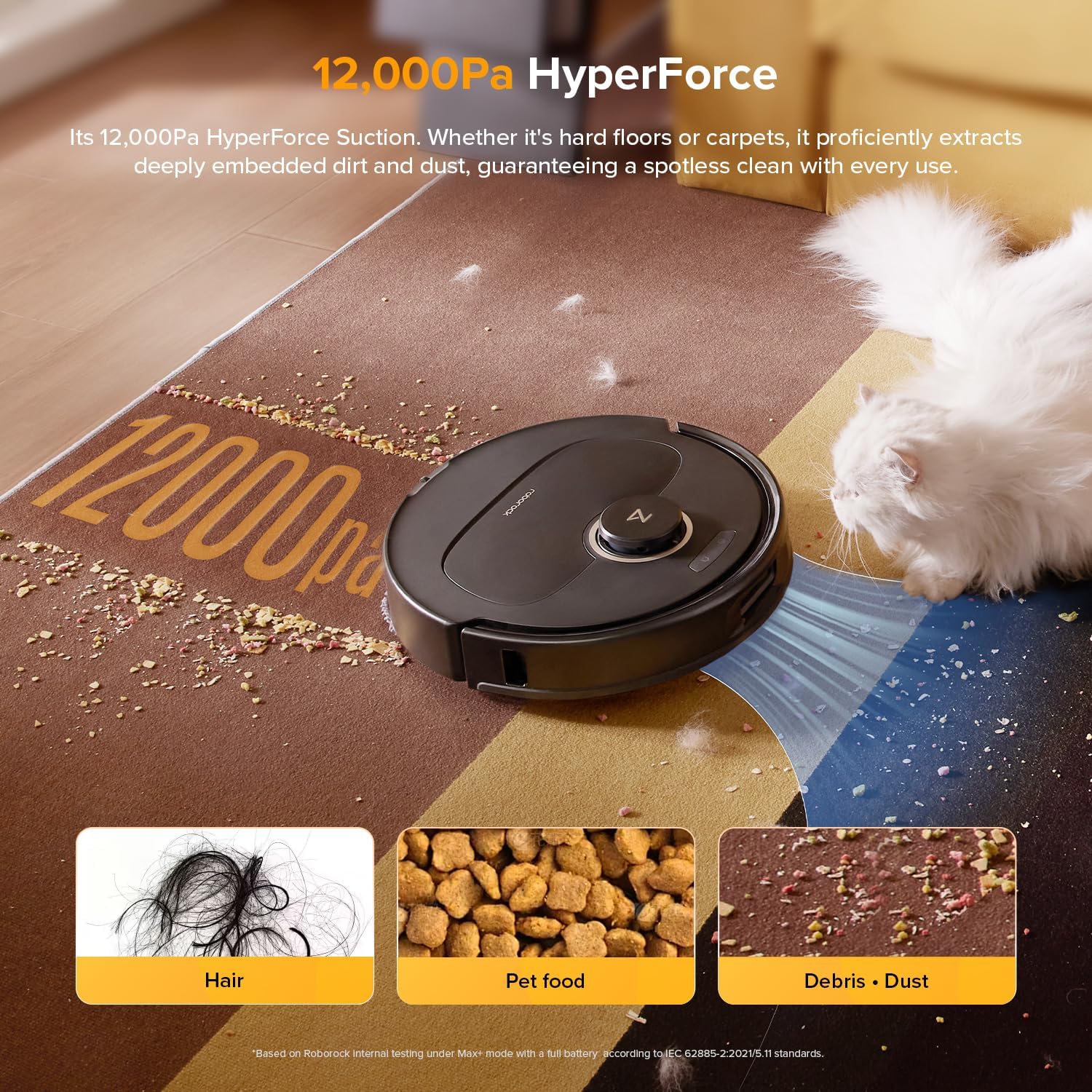
At the flagship tier, the headline spec on the Roborock Qrevo S5V is 12,000Pa of suction (Pa stands for pascals, a unit of pressure — higher numbers mean stronger airflow pull). Roborock’s own Q7 M5+ sits at 5,500Pa. The Ecovacs Deebot line’s upper tier units are rated in the 8,000–10,000Pa range depending on the model. On paper, 12,000Pa is a significant jump. But spec-sheet suction numbers have always required translation: what matters in practice is how that suction performs across different debris types and flooring — and here, early owners of the Qrevo S5V are the primary source of signal, since the unit’s review volume is still thin as of mid-2026.
The second major differentiator is the auto-lift mop. On older combo units — including budget Ecovacs models and earlier Roborock generations — the mop pad drags along the floor continuously, which means it either gets dragged across carpet (leaving moisture behind) or the robot has to avoid carpet zones entirely. The Qrevo S5V’s mop lifts automatically when it detects carpet, a mechanical solution to a real workflow problem. Owners who’ve used earlier drag-pad combos consistently describe this as the feature that finally made a combo unit usable in mixed-surface homes.
The third differentiator is the self-cleaning dock ecosystem. Flagship units in this tier typically include auto-empty dustbins, auto-refill mop water tanks, and hot-air drying for the mop pad. That’s what the dock footprint is paying for, and it changes the maintenance calculus dramatically.
The Reliability Question You Should Ask Before You Buy
Here’s where the honest analysis gets uncomfortable: the Roborock Qrevo S5V has a small but enthusiastic early review base. The most detailed long-form owner account we’ve found comes from a new mother running a structured weekly cleaning schedule across a roughly 1,900 square foot tiled home with three children under five. Her purchase driver was explicit — a previous Eufy unit died unexpectedly at 2.5 years, and she was not going back to a brand without a stronger reliability track record. She did extensive pre-purchase research and landed on the Qrevo S5V specifically because of Roborock’s brand consistency across their Q-series and S-series lines.
That’s a credible endorsement from someone who was burned before and knew what to look for. But it’s also one data point on a unit with limited long-run reviews. We’d be doing you a disservice to present it as an established reliability record.
The Q7 M5+, by contrast, has broader review coverage — and it includes a credible cautionary note. A one-star account describes a unit dying after a firmware update under 10 months of ownership. This isn’t unique to Roborock; firmware-related failures have been documented across Ecovacs and iRobot units in Wirecutter’s long-term notes as well. But it’s worth naming explicitly because firmware management is a real risk category in connected home appliances that most buyers don’t price into their decision.
By the numbers:
| Model | Suction (Pa) | Mop Type | Self-Clean Dock | Typical Street Price Range |
|---|---|---|---|---|
| Roborock Qrevo S5V | 12,000 | Auto-lift rotating disc | Yes | $800–$900 |
| Roborock Q7 M5+ | 5,500 | Fixed rotating disc | Yes (auto-empty) | $550–$650 |
| Ecovacs Deebot X2 Omni | ~8,000 | Auto-lift pad | Yes | $750–$1,000 |
Prices are approximate retail ranges as of May 2026 and will vary by retailer and promotion cycle.
App Experience and Multi-Zone Scheduling: Where Premium Earns Its Keep
If you’re managing a home with distinct zone requirements — say, daily kitchen and bathroom runs, but weekly-only bedroom schedules — the app layer is where the premium tier either justifies itself or frustrates you.
The Roborock app is consistently described by owners running complex multi-zone schedules as one of the more capable interfaces in the consumer robot vacuum space. The new mother running the Qrevo S5V in her 1,900-square-foot tiled home specifically praised the app’s zone-by-zone scheduling as functional and reliable across weeks of structured use. TechCrunch’s robot vacuum buying guide notes that Roborock’s mapping fidelity and zone customization have generally outpaced competitors at equivalent price points, citing the multi-floor map retention as a concrete advantage for larger homes.
The Ecovacs app ecosystem, in contrast, gets more mixed signals. Wired’s product desk notes that Ecovacs hardware has caught up meaningfully in the $700–$900 range, but software stability — particularly around map retention after firmware updates — remains a more consistent complaint category in owner reviews than it is for Roborock.
This matters operationally: if you’re setting up a weekly cleaning schedule and relying on it to run unsupervised, a map that resets after a firmware push is not a minor inconvenience. It’s a workflow failure.
What Happens When Firmware Goes Wrong
This deserves its own treatment because it’s the question most pre-purchase research skips.
When a connected robot vacuum fails after a firmware update — as one credible Q7 M5+ reviewer documented — your recourse options break down like this:
-
Manufacturer warranty claim. Most flagship robot vacuums carry a one-year limited warranty. If the failure is within that window and the manufacturer acknowledges the firmware connection, you’re likely covered. If the unit fails at month 14, you’re negotiating.
-
Credit card purchase protection. Many premium credit cards extend manufacturer warranties by one additional year. If you’re spending $700–$900 on a robot vacuum, this is worth checking your card’s terms before you buy.
-
Retailer return windows. Major retailers often have 30–90 day return windows for electronics, but firmware failures rarely happen in the first 30 days.
-
Community-sourced rollback documentation. For Roborock specifically, there are owner communities that document firmware version histories and report on problematic releases — this isn’t an official recourse, but it’s a real-world risk-mitigation tool that informed buyers use.
The honest summary: if firmware stability matters to you — and it should at this price — buying from a manufacturer with a robust support track record and a documented firmware rollback policy is a legitimate evaluation criterion, not a luxury concern.
Frequently Asked Questions
Is 12,000Pa suction noticeably better than 8,000–10,000Pa in daily use?
Early Qrevo S5V owners describe the suction as noticeably more powerful than prior robots they’ve owned, particularly for fine debris and pet hair embedded in grout lines and tile edges. Whether the delta between 10,000Pa and 12,000Pa is perceptible in a carpeted home with typical household debris is less clear — the Wirecutter review team notes that above a certain threshold, real-world suction performance depends more on brush roll design and seal quality than raw Pa rating. For tiled homes with texture, the high-Pa advantage seems more meaningful. For primarily carpeted homes, the difference may be marginal.
Does the auto-lift mop actually keep carpet dry, or does it still leave moisture?
Owners consistently report that the Qrevo S5V’s auto-lift mechanism works as described — the mop pad clears the floor surface before the robot transitions onto carpet, and carpet-specific moisture complaints are absent from early reviews. This is a meaningful improvement over drag-pad designs, where a damp pad inevitably contacts carpet edges at room transitions. That said, “dry” is relative: a robot mop at any price is applying a thin water layer, and if you have very low-pile carpet immediately adjacent to tile with no threshold, you should test conservatively on your specific flooring before committing to heavy-wet mopping schedules.
How does the Roborock app hold up for households with complex multi-zone schedules?
For structured multi-zone use — the kind where you want the kitchen and bathrooms run daily and bedrooms weekly, with different suction and water settings per zone — owner accounts describe the Roborock app as genuinely capable. Zone-specific scheduling, custom suction profiles, and map persistence across runs all receive consistent positive mentions. The app’s learning curve is real: setting up a complex schedule the first time requires patience, but owners running the system for months report that once configured, it runs reliably.
What happens to a $600+ robot vacuum when firmware updates go wrong — what recourse do owners have?
See the section above for the full breakdown. Short version: one-year manufacturer warranty is your primary tool, credit card extended protection is your backup, and buying from a brand with a documented support process for firmware-related failures is a pre-purchase decision worth making deliberately. The Q7 M5+ failure account is a real data point, not an isolated rumor — treat it as a category risk, not a reason to avoid Roborock specifically.
Is a tiled home a better use case for a combo vacuum-mop than a mixed-surface home?
Yes, clearly. The tiled-home owner using the Qrevo S5V is operating in close to the ideal use case: consistent surface type, no carpet-to-hardwood transition risk management, and a cleaning schedule where the mop function adds genuine value on every run. Mixed-surface homes still benefit from the auto-lift mop, but the scheduling complexity increases and the mop’s contribution on carpeted runs is zero. If more than 60% of your floor area is hard surface, a combo unit at this price tier makes strong sense. If you’re primarily carpeted with only a kitchen and bathrooms in hard surface, the mop premium may not be worth it — a dedicated high-end vacuum and a separate manual mop may give you better results per dollar.
How does the Qrevo compare to the Q7 M5+ for pet hair households?
The Q7 M5+ has a broader, longer-run review base in pet hair households, and owners consistently praise the rotating mop disc as meaningfully better than drag-pad designs at picking up pet hair trapped in grout lines. The Qrevo S5V’s higher suction rating is theoretically advantageous for pet hair embedded in floor textures, and early owners with pets describe strong performance — but the review base is thin enough that we can’t give you a long-run pattern comparison. If pet hair is your primary concern and reliability history matters to you more than maximum suction headroom, the Q7 M5+ has the track record advantage today.
The Decision Rule
If you’re on a tiled or predominantly hard-surface floor home, running structured multi-zone schedules, and reliability after a previous robot failure is your primary driver — the Roborock Qrevo S5V is the well-researched premium pick, with the caveat that you’re buying into a limited early review window and should factor in credit card warranty protection explicitly.
If you want proven reliability data before committing to flagship pricing — or if pet hair is your central use case and you want a longer owner track record — the Q7 M5+ gives you a tested mid-tier option with a meaningful performance record, and its one documented firmware failure is a known risk category, not a disqualifying pattern.
If you’re considering the Ecovacs Goat or the Deebot X2 Omni as cross-brand alternatives, the hardware has closed the gap, but the app stability gap — particularly around firmware-update map retention — is a legitimate differentiator that the Roborock ecosystem currently handles better based on aggregated owner accounts and Wired’s ongoing coverage.
The $600-plus tier earns its price in dock automation, app sophistication, and mop mechanics. Whether it earns it for your home depends on your floor type, your schedule complexity, and how much you want to bet on early-adopter reviews versus established long-run owner data.