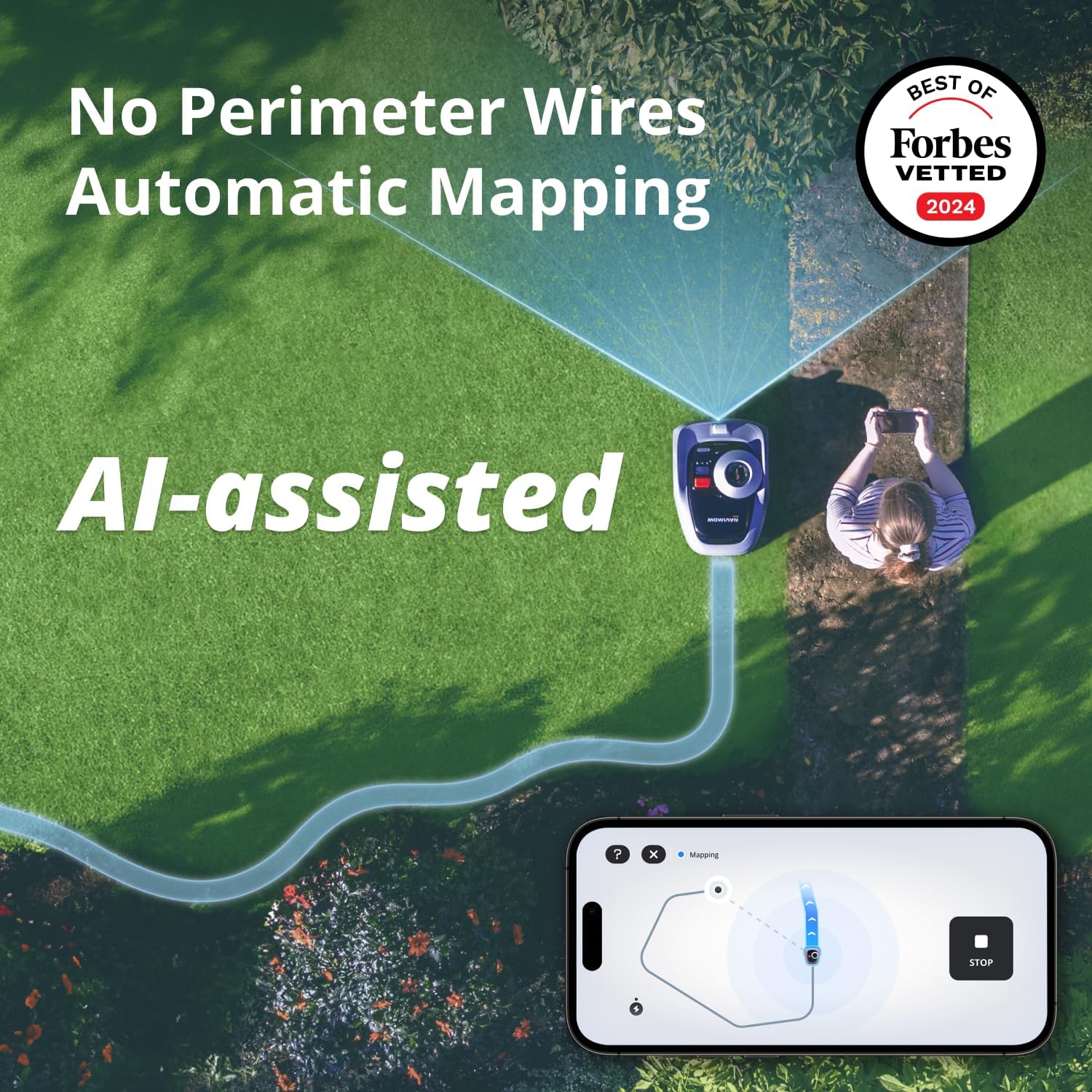
If you’ve been researching wire-free robot mowers — that means mowers that navigate your yard using GPS, RTK satellite signals, or LiDAR (a spinning laser sensor that maps the environment, like a self-driving car uses) rather than a buried boundary wire — you’ve almost certainly seen phrases like “TruEdge mowing,” “smart boundary trimming,” or “precision edge performance” scattered across product pages. These sound great. Edge mowing matters because the strip of grass right along a fence, driveway, or garden bed is the strip that makes your lawn look either finished or neglected. The promise of a robot handling that strip automatically is a big part of the value proposition. The honest question — the one this article will answer with real owner evidence — is whether current wire-free technology actually delivers on it, or whether you’re going to be pulling out a string trimmer every weekend regardless.
Spoiler: the answer is “it depends, and the marketing consistently overpromises.” Let’s walk through exactly what the evidence shows, model by model, and give you a clear decision frame for evaluating any mower’s edge claims before you buy.
| EDITOR'S PICKECOVACS Goat A2000 LiDAR PRO Ro… | Mid-tierSegway Navimow i105N Robot Lawn… | Budget pickWORX Landroid Vision Cloud Robo… | |
|---|---|---|---|
| Area covered | Up to 1/2 acre | 1/8 acre | 1/4 acre |
| Edge trimming | ✓ TruEdge trimmer | — | — |
| Navigation | Dual-LiDAR | RTK + Vision | RTK Cloud |
| Obstacle avoidance | ✓ AIVI 3D | — | ✓ AI-based |
| Quietness | — | 58 dB(A) | — |
| Zone support | — | Multi-zone | — |
| Price | $1,499.99 | $799.00 | $779.99 |
| See on Amazon → | See on Amazon → | See on Amazon → |
The Gap Between Marketing Language and Actual Edge Clearance
Here’s the core mechanical reality: a wire-free robot mower has to know where its boundary is before it can cut close to it. That knowledge comes from one of three sensor systems — RTK GPS (Real-Time Kinematic positioning, which uses satellite signals corrected by a fixed base station to achieve centimeter-level accuracy in ideal conditions), LiDAR (laser-based distance mapping), or computer vision (camera-based object recognition). Each has a different error profile at the boundary, and that error profile directly determines how close to the true edge the mower actually cuts.
The industry benchmark that matters is offset distance: how far from the mapped boundary edge does the mower’s blade actually reach? Any offset greater than about 3–4 inches means you have a strip of uncut grass that a string trimmer will need to clean up. Most brands don’t publish this number plainly — you have to infer it from owner experience.
By the numbers — real-world edge offset, owner-reported:
| Mower | Navigation | Reported Edge Offset | Manual Trim Still Needed? |
|---|---|---|---|
| Segway Navimow X430 | RTK GPS | ~2–3 in. | Rarely, for complex zones |
| ECOVACS Goat O1000 LiDAR PRO | LiDAR | ~4–6 in. (varies) | Weekly for most owners |
| WORX Landroid Vision | Vision AI | Indeterminate (software issues) | Yes — hardware unusable for many |
| Sunseeker X7 | RTK GPS | Out-of-bounds events reported | Yes — plus active troubleshooting |
Sources: aggregated owner reviews from the 2024–2025 retail review corpus for each model listed.
What Real Owners Are Actually Reporting
ECOVACS Goat O1000 LiDAR PRO: “Almost Fearful” at the Boundary
The phrase you’ll see in long-run owner accounts of the Goat O1000 LiDAR PRO is telling: reviewers describe the mower as behaving “almost fearful” near the mapped boundary. The LiDAR dome — a spinning sensor pod on top of the unit — is doing continuous distance mapping, and the mower’s conservative boundary interpretation means it pulls back from the edge earlier than you’d want.
The practical consequence, reported consistently across owner accounts in the 2024–2025 review corpus: owners are still running a push mower or string trimmer along their edges weekly. That’s not a failure of the mower’s core function — it mows the field area well — but it’s a direct contradiction of “set it and forget it” edge automation. There’s also a maintenance angle worth noting: LiDAR dome sensors require weekly cleaning to maintain consistent performance, according to owners. Grass clippings and moisture accumulate on the dome and degrade mapping accuracy, which in turn widens the conservative edge buffer the mower maintains.
If you’re evaluating this mower for a property where edge appearance is the primary driver, the owner evidence suggests you should budget time — and mental load — for weekly manual edge touch-ups regardless of what the marketing page says.
ECOVACS Goat A2000 and the “TruEdge” Claim
The A2000 is a more premium line from ECOVACS featuring what the company markets as a “TruEdge” trimmer mechanism — a physical design intended to let the blade reach closer to the mapped boundary than the O1000. On paper, this is the right engineering answer: a mechanical offset reduction paired with a physical blade position change.
The honest assessment as of mid-2026: independent reviewer evidence on actual TruEdge finish quality is limited. ECOVACS’s own marketing materials (ECOVACS Goat A2000 product specifications, 2025) describe the capability, but long-run owner accounts confirming consistent, string-trimmer-replacing edge quality haven’t aggregated in the way we’d need to call it validated. This isn’t a red flag — it may simply mean the product is newer and the review corpus is thinner. But if you’re making a purchase decision now, “trust but verify” applies: look for recent long-run owner accounts, not just launch-window impressions.
WORX Landroid Vision: When Software Breaks the Hardware Promise
The Landroid Vision case is instructive as a cautionary tale about the difference between hardware capability and software execution. Computer vision navigation — where cameras and AI models identify boundaries, obstacles, and terrain — is theoretically well-suited to edge work because it can see where the edge actually is, not just estimate it from GPS coordinates.
In practice, at least one detailed owner account (one-star review, aggregated retailer review corpus, 2024–2025) tells a more sobering story: this owner specifically chose the Landroid Vision over the Segway Navimow because of its edge offset adjustment tool in the app — a feature that matters deeply to edge-conscious buyers. What they found instead was software that was fundamentally broken at time of ownership: out-of-bounds excursions, app connectivity failures, and behavior that made the mower unsafe to run unsupervised. The hardware may be capable; the software stack, as experienced by this owner, was not.
This matters as a buying-decision frame because vision-based navigation is the most software-dependent of the three architectures. A firmware update can fix it — or the next update can break it again. If you’re evaluating the Landroid Vision, your due diligence should include checking the current firmware version’s community reputation, not just the spec sheet.
Segway Navimow X430: A Relative Bright Spot for Complex Yards
RTK GPS navigation, when it’s working correctly, offers a meaningful accuracy advantage at the boundary: centimeter-level positioning means the mower’s location is precisely known relative to the mapped perimeter, which allows for a tighter, more consistent edge offset. The X430 earns consistent praise from owners managing complex multi-zone yards with narrow corridors — exactly the kind of geometry that breaks other navigation systems.
Owners with irregular lots, gates, and tight passages between zones report that the X430 handles zone transitions and edge work in those constrained spaces better than alternatives. That’s a meaningful data point because narrow corridors are where edge performance and navigation accuracy intersect most directly. RTK signal quality is still environment-dependent — dense tree cover and tall structures can degrade it — but on properties with reasonable sky visibility, the X430’s edge consistency is owner-validated in a way the other systems covered here are not yet.
Sunseeker X7: GPS Promise vs. Out-of-Bounds Reality
The Sunseeker X7 occupies an interesting middle tier on price, but one-star owner accounts in the 2024–2025 review corpus paint a recurring picture of satellite calibration failures and out-of-bounds behavior — even when owners followed the setup directions precisely. This is a different failure mode than the Landroid Vision’s software issues; it’s a signal acquisition and map-lock problem. When RTK positioning fails to achieve a stable fix, the mower is essentially navigating blind, and “blind” near a boundary produces the worst possible outcome: excursions beyond the mapped edge.
This is worth naming explicitly for buyers: RTK accuracy is the ceiling, not the floor. The floor is what happens when the satellite fix degrades, the base station loses signal, or multipath interference (signals bouncing off structures) corrupts the position estimate. Any RTK mower’s edge performance needs to be evaluated not just under ideal conditions but under the worst-case signal environment your property actually presents.
Frequently Asked Questions
Will any current robot mower fully replace a string trimmer for edge work?
Based on the owner evidence available in mid-2026, no single wire-free robot mower reliably replaces a string trimmer for all users across all edge types. The Segway X430 comes closest for owners with favorable RTK conditions and relatively simple edge geometry. The honest answer for most buyers is: plan to spot-trim, evaluate how often over a season, and treat full edge replacement as a stretch goal rather than a baseline expectation.
Does LiDAR navigation produce better edge results than RTK in practice?
Not clearly. LiDAR’s boundary conservatism — the “almost fearful” behavior owners describe on the Goat O1000 — means it often maintains a larger effective offset than a well-tuned RTK system. RTK’s advantage is positional precision when signal quality is high. The practical edge result depends more on how aggressively the firmware is tuned to approach the boundary than on the sensor type alone.
What causes a robot mower to go out-of-bounds despite correct mapping?
The most common culprits, based on owner accounts and IEEE Spectrum’s 2024 overview of robot mower navigation challenges: RTK signal degradation from tree canopy or structure interference; multipath GPS errors near walls and fences; LiDAR sensor contamination from debris or moisture; and software bugs in boundary-enforcement logic. Correct initial mapping does not guarantee correct ongoing boundary adherence — signal and sensor quality matter continuously.
How close to the true yard edge do these mowers actually cut?
Owner-reported offsets range from roughly 2–3 inches (Segway X430 under good conditions) to 4–6 inches or more (ECOVACS Goat O1000 LiDAR PRO). Any offset above 3 inches is typically visible as an uncut strip and requires manual follow-up for a finished appearance.
Can edge performance be improved through app settings or firmware updates?
Sometimes, yes — boundary aggressiveness is often a tunable parameter in app settings, and firmware updates have meaningfully changed edge behavior on several platforms. The Landroid Vision’s software problems illustrate the inverse: a firmware regression can degrade working edge performance. Treat app and firmware state as a living variable, not a one-time setup task.
What yard shapes or obstacles make edge mowing especially difficult?
Concave corners (inside corners of fences, for example), narrow corridors between structures, and edges adjacent to raised obstacles like retaining walls are consistently the hardest cases. These geometries combine tight clearance requirements with the sensor conditions most likely to produce false readings or conservative retreat behavior. The Segway X430’s owner praise specifically in multi-zone yards with narrow corridors suggests RTK handles these better than LiDAR under current firmware — but it’s not a universal rule.
The Decision Frame
If edge performance is your primary evaluation criterion — not just a nice-to-have — here’s the honest if/then:
If your yard has clear sky exposure, a perimeter-dominant shape, and edge appearance is critical: RTK GPS (specifically the Segway X430 based on current owner evidence) gives you the best foundation. Budget for occasional manual touch-up anyway; set your expectation at “significantly reduced trimming” rather than “none.”
If your yard is heavily shaded or surrounded by tall structures: RTK signal quality will degrade, which undermines the core advantage. No current wire-free system has a strong owner-validated edge performance record under these conditions. A boundary-wire system may be the more honest choice for your use case.
If you’re drawn to a vision-based system like the Landroid Vision: verify current firmware reputation before committing. The hardware may deliver on its promise; the software history warrants a “wait for stability” posture unless recent owner accounts confirm it’s resolved.
If “set and forget” edge automation is non-negotiable: the current generation of wire-free robot mowers isn’t there yet. That’s not a permanent verdict — it’s a 2026 snapshot. But it’s the evidence-based one.