If your yard is about a quarter acre—roughly 10,000 square feet, or just enough space that pushing a mower every week genuinely costs you an hour—a robot mower starts to make real financial sense. The pitch is simple: you set it up once, and it handles the grass on a schedule you control from your phone. But “set it up once” is doing a lot of work in that sentence. How the robot figures out where it is and where it’s allowed to go turns out to be the core of every buying decision at this price tier. There are two dominant approaches right now. The first is RTK GPS—a precision satellite positioning system accurate to within a couple of centimeters instead of the several-foot margin of ordinary GPS—that lets the mower navigate without burying any boundary wires. The second is LiDAR, which uses rapid laser pulses to build a real-time map of obstacles in the robot’s path, often combined with cameras or ultrasonic sensors. Each system has a different setup story, a different failure mode, and a meaningfully different total cost. This article walks you through the tradeoffs so you can make the call that fits your lot, your soil, and your budget.
RTK Navigation: What You’re Actually Buying
RTK stands for Real-Time Kinematic positioning. A small fixed base station—usually a stake-mounted antenna placed somewhere elevated and clear of obstructions in your yard—talks continuously to the mower and to GPS satellites, correcting the tiny timing errors that make ordinary GPS imprecise. Manufacturers including Husqvarna and Mammotion publish sub-2-cm positional accuracy under good sky conditions in their product specifications, a figure corroborated in field testing documented by The Robot Report in their 2024 report “RTK GPS in Consumer Robotics: Accuracy Benchmarks and Field Performance.”
The practical implication is significant: the mower can hold to a programmed mowing path precisely enough that it doesn’t need a buried perimeter wire to know where the property edge is. You define boundaries digitally in an app, usually by walking the edge with your phone. No wire trenching. No week-long installation project. This is the core RTK value proposition, and it is real.
But here’s the tradeoff the spec sheet doesn’t surface: RTK performance degrades in anything less than an open sky. Dense tree canopy, tall privacy fences, two-story buildings on a north-facing lot—each can occlude the satellite signal enough to introduce drift. The Robot Report’s 2025 report “Mammotion Luba 2 AWD and RTK Navigation: Long-Term Owner Reports” identifies canopy interference as the number-one source of unplanned boundary violations in residential RTK deployments. Owners report the mower occasionally wandering past a defined boundary when satellite lock degrades—on a quarter-acre lot with a garden bed along the fence line, that is not a minor annoyance.
The other RTK-specific cost buyers don’t anticipate is connectivity dependency. Most RTK systems rely on a 4G/LTE cellular correction network or require a persistent Wi-Fi connection for the base station. Some manufacturers bundle this connectivity for two to three years; after that, a subscription typically runs $50–$120 per year based on published service terms from Mammotion and Segway Navimow as of early 2026. It won’t break your budget, but it is a recurring line item that belongs in your total-cost-of-ownership math.
Budget RTK: Entry-Level Wire-Free Mowing
For buyers prioritizing low entry cost and open, obstacle-light yards, the current value tier in RTK navigation sits between $1,200 and $1,600. Units in this range handle up to 10,000–12,000 square feet, include the base station antenna, and require app-only boundary setup with no professional installation required. Connectivity subscriptions are typically bundled for the first two years, keeping first-year total cost of ownership predictable. This tier is the right starting point for anyone with a largely rectangular, canopy-free lot who wants to validate the technology before spending more.
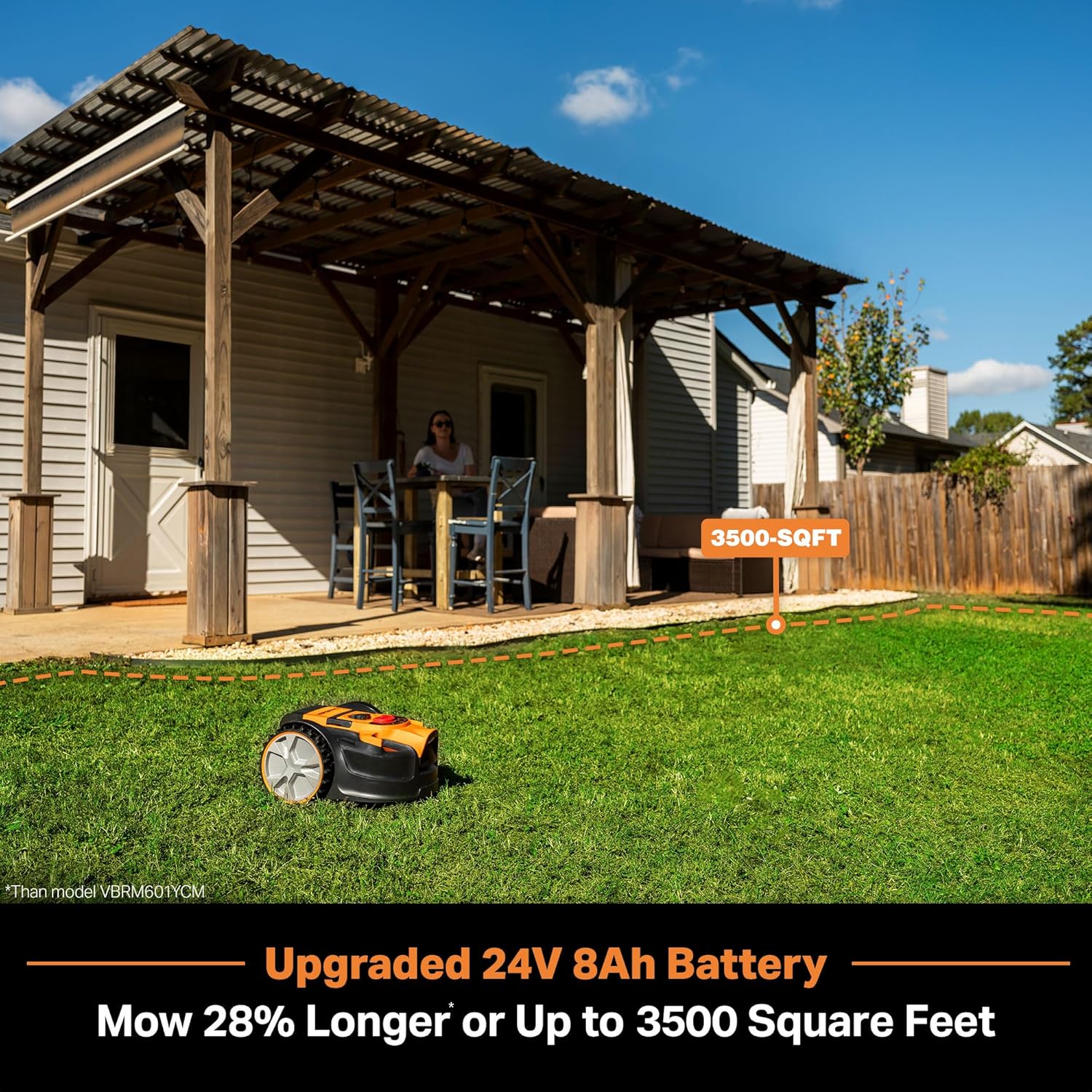
LawnMaster
$399.97
In stock on Amazon
Check price on AmazonMid-Tier RTK: Better Canopy Tolerance and Slope Handling
The mid-tier RTK segment ($1,600–$2,200) adds slope handling up to 45%, improved multi-band satellite reception that partially mitigates canopy interference, and better companion-app mapping tools. The Mammotion Luba 2 AWD surfaces most consistently in owner aggregation at this use case for the 2025–2026 buying window, as documented in The Robot Report’s 2025 long-term owner report cited above. Segway Navimow H series units occupy the same tier and are frequently cited alongside it in head-to-head coverage published by Robotics and Automation News. If your yard has modest shade or a slope section, this tier earns its premium over the budget entry point.
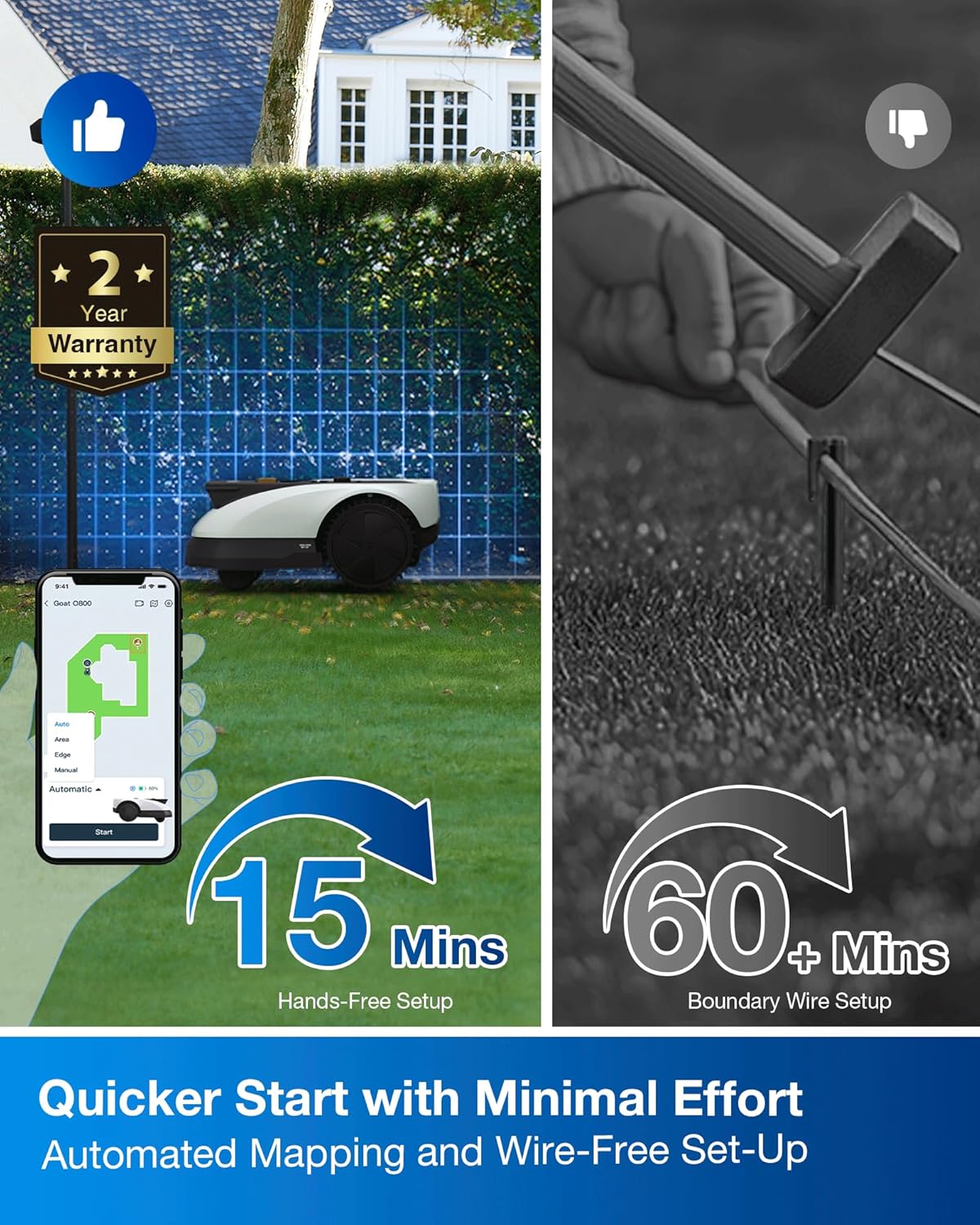
ECOVACS
$699.00
In stock on Amazon
Check price on AmazonPremium RTK-Plus: Professional Setup, Hybrid Positioning
At $2,200–$3,200, the premium RTK tier adds professional dealer installation, hybrid positioning that blends RTK with inertial and visual odometry to partially compensate for canopy dropout, and multi-zone mapping that handles properties with separate lawn sections. Husqvarna’s EPOS (Exact Positioning Operating System) platform is the reference implementation here, combining RTK-level positioning with professional setup and a support contract covering connectivity infrastructure. Robotics and Automation News covered the EPOS platform in depth in their 2025 system review “Husqvarna EPOS and Boundary-Wire-Free Mowing Systems Review,” positioning it as the standard against which other wire-free residential systems are measured. Buyers with complex lots, significant canopy, or a low tolerance for DIY troubleshooting will find the professional installation component alone justifies the price step.
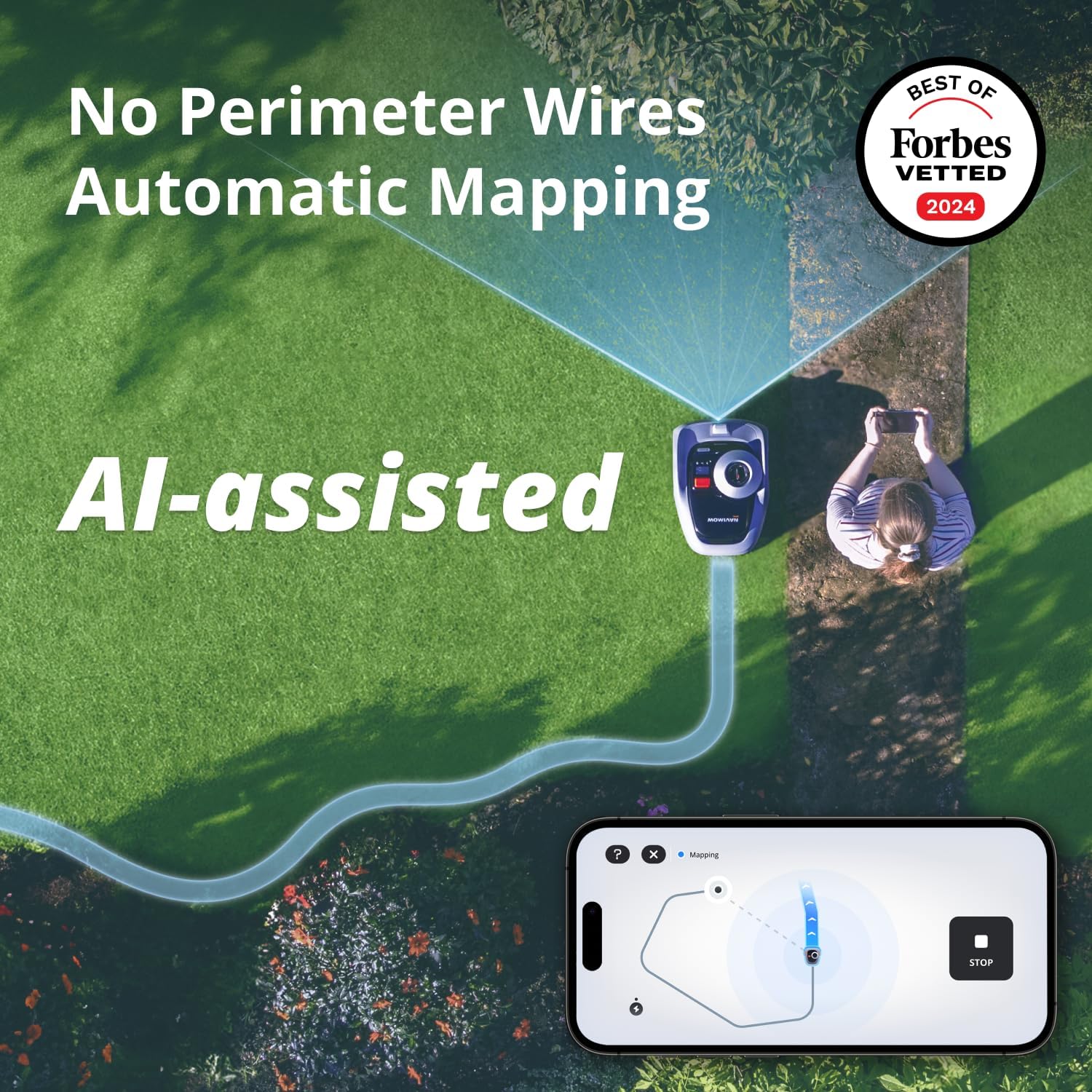
Segway
$799.00
In stock on Amazon
Check price on AmazonBy the numbers — RTK setup on a typical quarter-acre:
| Cost Item | Estimate |
|---|---|
| Robot mower (RTK, mid-range) | $1,200–$2,200 |
| Base station antenna + mounting hardware | $0–$150 (often included) |
| App-based boundary setup (DIY, 1–2 hrs) | $0 labor if self-installed |
| Annual RTK correction subscription (yr 2+) | $50–$120/yr |
| Blade replacement set (annual) | $20–$45/yr |
Compare that to a boundary-wire system at the same yard size, where professional wire installation on a quarter acre typically runs $300–$800 based on installer quotes aggregated by Robotics and Automation News in their 2025 buyer coverage—and that wire is a permanent infrastructure liability if it ever needs repair.
LiDAR Navigation: The Sensor-Rich Alternative
LiDAR-equipped mowers take a fundamentally different approach: instead of knowing exactly where they are in absolute space, they understand what is immediately around them with high resolution and build a working map on the fly. The LiDAR unit spins and fires thousands of laser pulses per second, constructing a real-time point cloud of the environment. Paired with cameras, wheel odometry, and sometimes ultrasonic sensors, this creates a system that is genuinely better at obstacle detection than RTK-only units at equivalent price points.
The obstacle avoidance advantage is documented in technical reporting. IEEE Spectrum’s 2024 feature “LiDAR Comes to the Lawn: Sensor Fusion in Outdoor Autonomous Platforms” notes that LiDAR-camera fusion systems operating at 10 Hz or above reliably detect objects as small as a garden hose at 2-meter range—a threshold that ultrasonic-only systems frequently miss. For yards with toys, garden tools, pet waste, and irregular terrain, this matters in practice.
The tradeoffs are real, however.
LiDAR units are more expensive at equivalent mowing coverage area. Buyers typically pay a $400–$800 premium over a comparable RTK model before considering that sensor calibration and firmware complexity introduce failure modes that don’t exist in GPS-centric systems.
Mapping takes time. Most LiDAR mowers require a supervised learning period across several mowing sessions before the internal map stabilizes. Until then, the machine runs conservatively—slower, more cautious, with a higher rate of false-positive stops. Owner reviews aggregated across multiple LiDAR platform reviews published by The Robot Report describe a two-to-four-week shakeout period while the mower learns permanent yard features.
Weather affects LiDAR differently than RTK. Heavy rain and dense fog scatter laser pulses and degrade point-cloud quality. A solid RTK system keeps working in rain—satellite signal is unaffected by precipitation. A LiDAR system may slow down, pause more often, or produce incomplete obstacle maps in wet conditions. For a quarter-acre lot in the Pacific Northwest or along the Gulf Coast, this is worth pricing into your decision.
The Setup Cost Nobody Mentions
Wired’s 2024 investigation into robot mower ownership, “The Hidden Costs of Robot Lawn Mowers,” identified a consistent pattern across buyer reports: the “one-time setup” is rarely one time, and it is rarely free. Here is what the category tends to undercount regardless of navigation architecture.
Yard prep labor. Both RTK and LiDAR systems perform significantly better on yards that have been prepared: edging defined, garden bed borders clearly delineated, low-hanging branches trimmed, cables and hoses stored. On a quarter-acre, budgeting 4–6 hours of initial prep work is realistic if your yard has any complexity. If you’re hiring that out, add $100–$250 to your first-year cost.
Wi-Fi or cellular dead zones. RTK base stations need reliable connectivity to transmit correction data. If your router doesn’t reach the back yard, you’re looking at a Wi-Fi extender or mesh node ($80–$200) before the mower will operate reliably. This surfaces during installation, not at purchase, and it consistently surprises buyers.
Slope re-mapping. Quarter-acre lots often include grade changes—a sloped back section, a raised planting area, a drainage swale. Most robot mowers handle up to 35–45% slopes per manufacturer-rated specs, but slope transitions require manual path refinement in the app. Owners consistently report spending 2–3 hours on slope zone configuration that the marketing materials don’t mention.
The annual blade math. Robot mower blades are small, razor-style replaceable units. On a 10,000-square-foot yard mowing three times per week in season, blade replacement runs every 8–10 weeks. Replacement sets cost $15–$45 depending on model. Annualized, that is $80–$200 per year in consumables—a number that belongs next to the purchase price in any honest total-cost-of-ownership calculation.
The Decision Framework: Which Navigation System Fits Your Yard
Here is the framework that should drive your final call.
If your yard has significant tree canopy, garden beds within 18 inches of the mowing boundary, or consistent cloud cover in your region — lean LiDAR. The RTK boundary drift in occluded-sky conditions will cost more in re-mapping time and damaged beds than the LiDAR premium is worth. The obstacle-detection advantage documented by IEEE Spectrum in “LiDAR Comes to the Lawn” also pays off in yards with irregular features and frequent obstacles.
If your yard is open, roughly rectangular or trapezoidal, with clean sightlines to the sky and minimal obstacle density — RTK is the better value. Setup is faster, weather resilience is higher in wet conditions, and you are not paying for sensor complexity you don’t need.
If you’re on the fence and total cost of ownership matters more than sticker price: Run the five-year math. An RTK unit in the $1,400–$1,800 range with $80 per year in subscriptions and $150 per year in consumables comes to roughly $2,550 over five years. A LiDAR unit starting at $2,200 with higher consumables but no subscription fee lands around $3,000. The gap is real but not enormous—and it narrows further if you would otherwise be paying for professional lawn mowing service. At widely reported national averages of $45–$65 per mow, a quarter-acre getting mowed weekly from April through October runs $1,260–$1,820 per season. Payback on either technology is roughly 18–24 months.
The one universal recommendation: whichever navigation system you choose, budget $300–$500 above the unit price for first-year setup costs—yard prep, connectivity infrastructure, and the learning-curve hours that nobody puts on the box. Wired’s reporting in “The Hidden Costs of Robot Lawn Mowers” found that buyers who felt burned by robot mowers almost always skipped that buffer. The buyers who felt genuinely satisfied almost always planned for it.
Your next step: map your yard’s canopy density and obstacle count before you look at a single spec sheet. That one environmental variable will narrow your decision to one navigation architecture faster than any comparison chart we could give you.
How the Tiers Compare
For readers weighing price against capability, here’s how the standout picks break down by budget level.
Best Budget Pick
At $578.99, this is the value option in this lineup — it covers the essentials without the premium-tier cost, the smart starting point if you’re weighing price against capability.
LawnMaster
$399.97
In stock on Amazon
Check price on AmazonBest Mid-Range Pick
At $699.00, this is the balanced choice — it closes most of the gap to the high end while staying well short of premium pricing, which is why it’s the pick most buyers actually land on.
ECOVACS
$699.00
In stock on Amazon
Check price on AmazonBest Premium Pick
At $999.99, this is the top performer here — you pay for it, but if capability and longevity matter more than the upfront cost, this is the one to beat.
Segway
$799.00
In stock on Amazon
Check price on Amazon