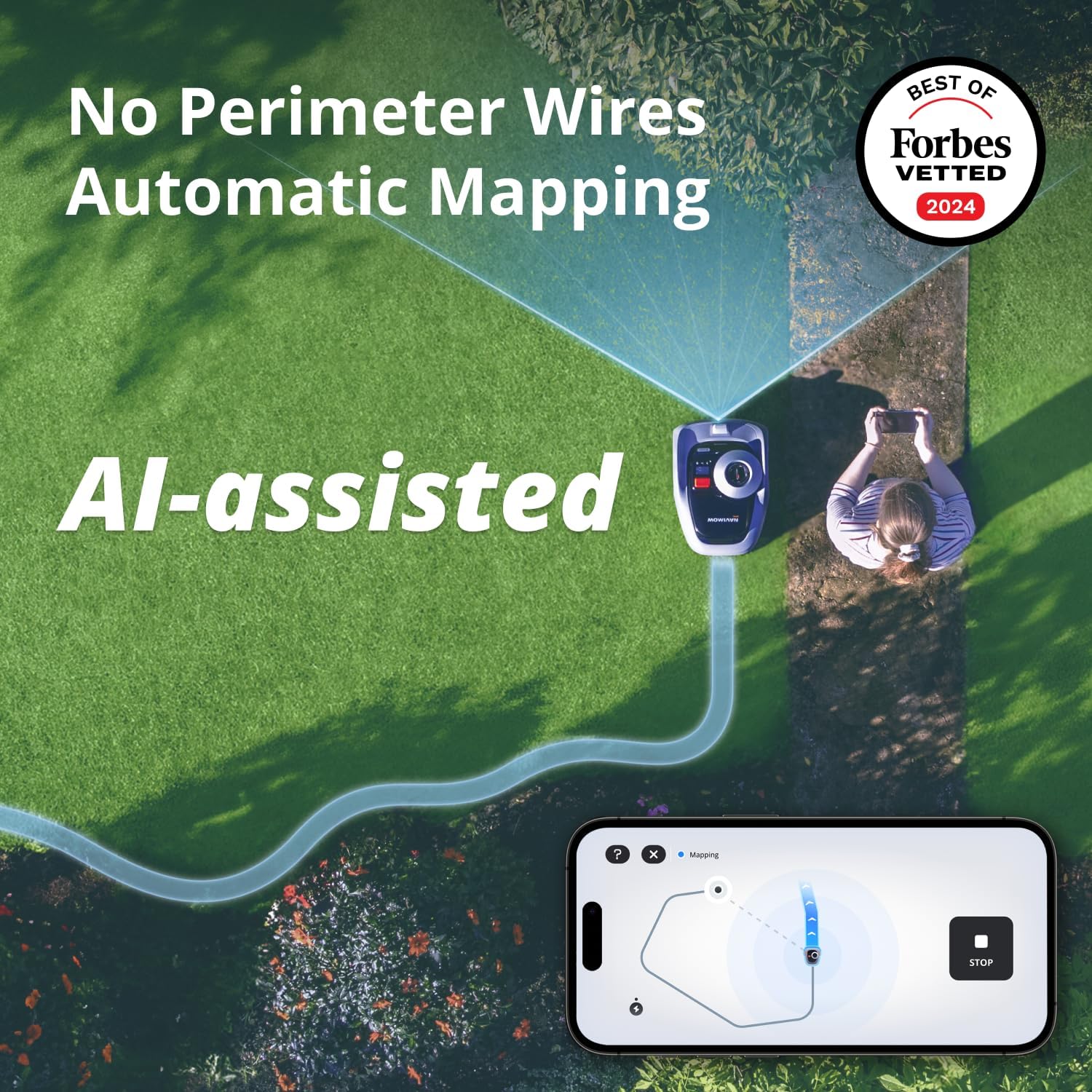
Wire-free robot mowers are exactly what the name suggests: autonomous lawn-cutting machines that navigate your yard without you first burying a physical boundary wire around every edge and obstacle. Instead of that weekend of digging, they use technologies like RTK GPS (a precision satellite positioning system accurate to a few centimeters), LiDAR (laser-based distance sensing, the same family of tech used in self-driving cars), or computer vision (cameras that recognize edges and obstacles) to figure out where the lawn is and where it isn’t. The pitch is compelling — unbox, app-pair, mow. The reality, as aggregated owner reports consistently show, is messier. This article is for buyers who are past the “is this category real?” stage and are now asking the harder question: which of these products will actually work in my specific yard, and what’s going to go wrong first? We’ll walk through the real setup timelines, the firmware failure modes that mirror patterns from the robot vacuum world, and the hardware quirks that separate tinkerer-friendly platforms from plug-and-play disappointments.
| EDITOR'S PICK[ECOVACS Goat A2000 LiDAR PRO](https://www.amazon.com/dp/B0HDB23LRT?tag=greenflower20-20) Ro… | Mid-tier[Segway Navimow i105N Robot Lawn](https://www.amazon.com/dp/B0CX8LL2PC?tag=greenflower20-20)… | Budget pick[LawnMaster OcuMow™ VBRM601YCM](https://www.amazon.com/dp/B0GYFJCJJJ?tag=greenflower20-20) M… | |
|---|---|---|---|
| Coverage | 1/2 Acre | 1/8 Acre | 2000-3500 sq ft |
| Nav system | Dual-LiDAR | RTK+Vision | Optical |
| Obst avoidance | AIVI 3D | — | Obstacle Avoidance |
| Edge trim | TruEdge | — | — |
| App control | Smart App | APP Control | — |
| Quiet op | — | 58dB(A) | Low Noise |
| Price | $1,499.99 | $799.00 | $399.97 |
| See on Amazon → | See on Amazon → | See on Amazon → |
The “10 Minutes” Myth: What Setup Actually Costs You
The single most honest data point in any wire-free mower review category right now comes from ANTHBOT M5 owners, where one owner’s assessment cuts straight through the marketing noise: “10 minutes is marketing, 1 hour is realistic.” That gap isn’t specific to one brand — it’s a structural truth about how this category works in 2025 and 2026.
Here’s why the hour is real, not pessimistic:
-
RTK base station alignment — Products using RTK GPS require you to place and register a reference station that communicates with satellites to establish a precise fixed point. Getting a clean satellite lock in a backyard with tree canopy, a fence, or a multi-story structure nearby can take 15–30 minutes by itself on a first setup, and the app workflows for most brands aren’t yet as polished as, say, a mesh Wi-Fi setup.
-
Perimeter mapping passes — Unlike a robot vacuum where you press a button and it learns the room, most wire-free mowers need you to manually walk or drive the robot around the yard boundary while it records the GPS trace. If you have complex zones — a side yard, a back yard disconnected from the front, a strip along a driveway — each zone is a separate mapping pass.
-
No-go zone placement — Flower beds, swing sets, downspout splash blocks, and low tree branches all need either virtual no-go zones drawn in the app or physical marker stakes. This is iterative; you’ll almost certainly need to refine it after the first mow.
-
Connectivity handshake — Most platforms require app account creation, cloud registration, and sometimes a firmware update before the first mow is even possible. If your Wi-Fi signal at the dock location is marginal, add troubleshooting time.
The honest pre-purchase calculation: budget two to four hours across the first weekend, not one. For buyers with straightforward, open, rectangular yards, you might land closer to 90 minutes. For anything with irregular boundaries, partial shade, or multiple disconnected zones, a half-day is realistic. Owners of several platforms — ANTHBOT, Segway Navimow, ECOVACS Goat — consistently report this in long-run reviews, and Wired’s coverage of the autonomous lawn care category has flagged setup friction as the primary adoption barrier in 2025.
Firmware Failures, Warranty Gray Zones, and the OTA Risk
If you’ve followed robot vacuum coverage — specifically the pattern of Roborock OTA (over-the-air) firmware updates breaking map data or disabling features overnight — the ECOVACS Goat A2000 LiDAR PRO situation will feel familiar. One owner reports a locked wheel appearing approximately one month after purchase, with the suspected cause being firmware-related and the unit currently awaiting warranty replacement as of recent reviews. That’s a specific and concerning pattern: a hardware symptom (locked wheel) in a time window (one month post-purchase) that aligns with a firmware push rather than a manufacturing defect at the unit level.
IEEE Spectrum’s coverage of OTA firmware in automation devices has consistently noted that the firmware-hardware interface in consumer robots is a high-failure surface precisely because manufacturers push updates to large fleets simultaneously, with limited regression testing on edge-case hardware configurations. The risk calculus for buyers:
By the numbers:
- Typical wire-free robot mower warranty window: 1–2 years (varies by brand and region)
- OTA update frequency across major platforms: monthly to quarterly
- Warranty coverage of firmware-induced hardware failure: inconsistent — most manufacturer language covers “manufacturing defects,” and a firmware-bricked motor controller occupies a genuinely ambiguous space
- User-reported time-to-resolution on warranty claims in this category: 2–6 weeks (per aggregated reviews at The Robot Report’s 2025 landscape review)
The practical implication: if you’re evaluating a wire-free mower for a household where a two- to six-week lapse in mowing creates a real hardship — and we’ll come back to why that matters — warranty responsiveness should be a first-order selection criterion, not an afterthought. Ask the retailer directly what the replacement policy is for firmware-related failures, and document the firmware version at time of purchase.
Platform-by-Platform: Where the Real Trade-offs Live
Segway Navimow i105N — Tinkerer’s Platform, Not Plug-and-Play
The Navimow line has earned genuine respect for its RTK accuracy on open lots, but owner-reported issues with the i105N reveal a product that rewards modification. One owner found the official Segway-supplied heavy-wheel fix for ground-clearance issues insufficient, then engineered a custom ground-clearance modification and documented it with photos. That’s a meaningful signal: this is a platform for buyers who are comfortable with iteration, who treat the purchase as a starting configuration rather than a finished product.
Robotics and Automation News’ 2025 adoption review notes that RTK-based platforms like the Navimow consistently outperform vision-based platforms in open yards with minimal obstacles, but degrade in performance in yards with dense landscaping, uneven terrain, or significant grade changes. If your yard has more than a few inches of terrain variation across its length, the Navimow’s navigation accuracy advantage shrinks, and the clearance issues owners report become more frequent. Trade-off in plain terms: buy this if you want the most precise GPS boundary fidelity available at its price tier, and you’re willing to troubleshoot hardware fit. Do not buy it expecting zero post-purchase engineering.
WORX Landroid Vision — The Starkest Warning in the Category
One owner’s description of the Landroid Vision experience deserves to be quoted plainly: it requires “a techy, an astronomer, and lots of patience,” and it worked reliably only once despite what the same owner acknowledged was good customer support. That’s a remarkable review structure — the support is good, the product is unreliable. It suggests WORX’s customer-facing team is competent but the underlying vision navigation system is not yet mature enough for general consumer deployment.
The Landroid Vision uses computer vision rather than RTK or LiDAR, which is theoretically the most boundary-wire-free approach (no base station, no perimeter walk required). In practice, vision systems struggle with lighting consistency — overcast days, dusk, and shade from structures create edge-case failures that GPS and LiDAR don’t encounter. Wired’s category analysis notes that vision-based navigation remains the least reliable in adverse-light conditions across current consumer platforms. Decision rule: if your yard has significant shade coverage or you’re in a region with consistently overcast summers, a vision-based platform is a higher-risk choice in 2026.
ANTHBOT M5 — The Honest Middle Ground
The ANTHBOT M5 draws the most straightforward long-run owner reviews in the category: setup is harder than marketed, but once configured, it performs consistently. That’s actually a favorable reliability profile compared to the Navimow’s clearance issues and the Landroid Vision’s intermittent failures. It’s the platform most comparable to what early Roborock users experienced — a product that asks for patience upfront but delivers stability afterward. If you’re evaluating this for a household where mowing reliability is non-negotiable (more on that framing below), the M5’s owner-reported post-setup reliability places it ahead of the more technically ambitious alternatives.
The Hardship Case: Why Reliability Isn’t Just About Convenience
It would be easy to frame all of these trade-offs as premium-consumer inconveniences — the kind of thing that matters to a hobbyist but not to someone with real stakes. But one owner report in this category reframes the entire conversation: a buyer whose household includes children with autism and ADHD describes the robot mower as solving a genuine hardship. Lawn maintenance that requires noise, extended outdoor disruption, and unpredictable schedule intrusion creates real stress in that context. The mower isn’t a gadget; it’s infrastructure.
That framing should shift your evaluation criteria if you or anyone in your household has needs that make mowing disruption genuinely difficult — physical limitations, sensory sensitivities, caretaking responsibilities, or medical schedules. For those buyers, the Landroid Vision’s intermittent failure profile isn’t a tolerable quirk; it’s a product that shouldn’t be on the shortlist. Warranty response time isn’t a nice-to-have; it’s a critical spec. If reliability is load-bearing in your household, the decision rule is simple: prioritize platforms with the most consistent long-run owner reports over platforms with the most impressive navigation specs.
Frequently Asked Questions
How long does it realistically take to set up a wire-free robot mower from unboxing to first full mow?
Based on aggregated owner reports across multiple platforms, plan for 90 minutes in the best case (open rectangular yard, strong Wi-Fi at dock location, no firmware update required) and three to four hours in a realistic average case. Complex yards with multiple zones, significant tree canopy, or poor cellular/Wi-Fi signal at the installation site can push this to a full day across two sessions.
What happens if a firmware update bricks or breaks my robot mower — is it covered under warranty?
This is genuinely unsettled across most manufacturers. Standard warranty language covers manufacturing defects, which firmware-induced failures may or may not qualify as, depending on how the failure presents. The ECOVACS Goat locked-wheel case is a live example of this ambiguity. Before purchase, ask the seller explicitly whether firmware-related hardware failures are covered, and get it in writing if possible. Document your firmware version at time of unboxing.
Does RTK navigation work better than LiDAR for yards with lots of obstacles?
Not necessarily. RTK GPS is highly accurate for boundary definition but doesn’t inherently detect obstacles — it knows where the robot is, not what’s in front of it. LiDAR actively senses the environment in real time, which gives it an advantage in obstacle-dense yards. For open yards with clean boundaries, RTK-based platforms like the Navimow tend to outperform. For yards with bird baths, garden furniture, hoses, and irregular landscaping, LiDAR’s real-time sensing is more relevant. Per The Robot Report’s 2025 landscape review, the two technologies are increasingly being combined in higher-end platforms precisely because neither is sufficient alone.
Why does my robot mower keep getting its nose stuck in shallow ground dips, and is there a fix?
Ground clearance is a persistent hardware issue across nearly all current wire-free platforms — the Segway Navimow i105N being the most documented case. The root cause is that most robot mowers sit low to the ground for cutting height consistency, which makes shallow terrain transitions (a lawn edge, a root ridge, a transition from grass to gravel) a clearance problem. Official fixes (heavier wheels, different caster configurations) have had mixed results per owner reports. The most successful documented resolution involves custom spacer modifications to increase ground clearance — a solution that works but voids warranty on most platforms. Short-term: map those dips as no-go zones until a permanent fix is in place.
Can wire-free robot mowers handle yards that need cutting every 5 days in hot climates?
High-frequency mowing (every four to five days) is within the operational design intent of most platforms — they’re built for frequent, shallow passes rather than infrequent deep cuts. The practical constraint is battery runtime and dock charging time. Most current platforms handle a standard suburban lot (5,000–8,000 sq ft) in one to two hours of runtime, with a two- to three-hour recharge. In a hot climate where grass growth is aggressive, confirm the manufacturer’s rated mowing capacity against your actual lot size with some margin. Operating in peak heat (above 95°F) may also affect battery longevity over a multi-season ownership window — a factor that owner long-run reviews in Sun Belt states flag but that most spec sheets don’t address directly.
The wire-free mower category is real, and it’s genuinely improving. But in 2026, it still rewards buyers who go in with honest expectations: setup takes longer than the box says, firmware is a live variable you don’t fully control, and platform reliability varies in ways that matter enormously depending on your household’s actual stakes. Do the math on your yard complexity, your tolerance for iteration, and how load-bearing reliable mowing actually is for you — then match the platform to that profile, not to the most impressive spec sheet.