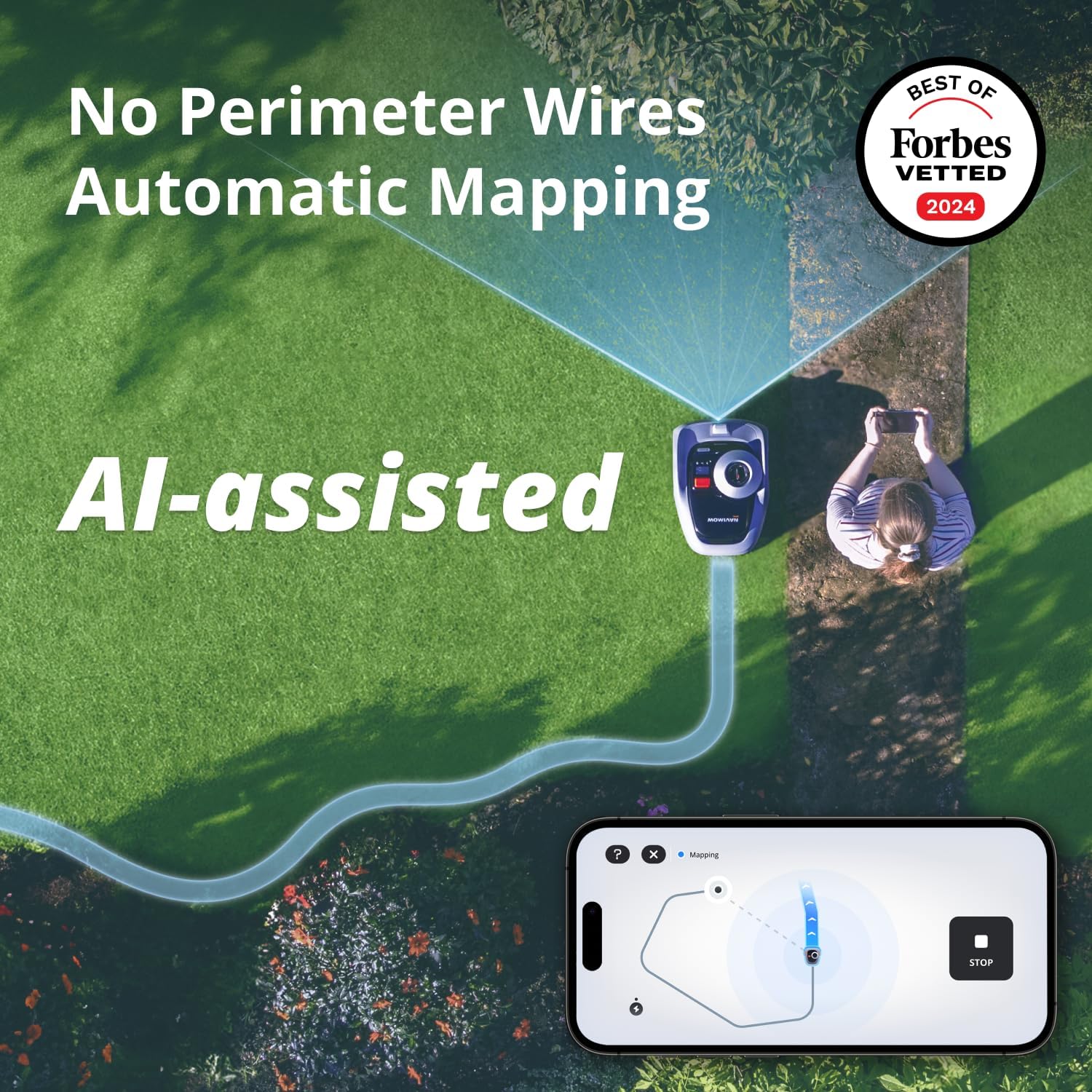
Robot mowers are autonomous cutting machines that navigate your lawn without you pushing anything — you set a schedule and they go. Traditional models use a buried boundary wire (think: an underground fence) to know where to stop. Wire-free models skip that wire entirely, instead using either RTK GPS (a precision satellite-positioning system that uses a fixed antenna on your property to triangulate the mower’s location to within a few centimeters) or Vision AI (onboard cameras and computer vision that recognize obstacles and lawn boundaries in real time). Both approaches promise the same outcome: no weekend mowing, no wire installation, just a tidy lawn. The catch — and this article is really about that catch — is that both systems have specific environmental requirements that can make them work brilliantly or fail embarrassingly, and those requirements interact with yard geometry in ways the marketing materials don’t fully explain. By the end of this piece, you’ll have a clear framework for knowing which technology fits your specific yard, which products owners praise or curse and why, and when walking away is the smartest move.
| EDITOR'S PICK[Segway Navimow i105N Robot Lawn](https://www.amazon.com/dp/B0CX8LL2PC?tag=greenflower20-20)… | Mid-tier[ECOVACS Goat O1000 RTK Robot La](https://www.amazon.com/dp/B0GJ4F8MLF?tag=greenflower20-20)… | Budget pick[LawnMaster OcuMow™ VBRM601YCM M](https://www.amazon.com/dp/B0GYFJCJJJ?tag=greenflower20-20)… | |
|---|---|---|---|
| Area coverage | 1/8 Acre | 1/4 Acre | 2000-3500 sq ft |
| Navigation | RTK+Vision | RTK | Optical |
| Mapping | AI-Assisted | Automated | — |
| Obstacle avoid | — | 3D | ✓ |
| Noise | 58dB(A) | — | Low |
| Multi-zone | ✓ | — | — |
| Price | $799.00 | $699.00 | $399.97 |
| See on Amazon → | See on Amazon → | See on Amazon → |
The Two Technologies, and Why the Choice Is Made by Your Yard, Not Your Budget
Before comparing products, you need to internalize one decision: RTK GPS or Vision AI? This isn’t a quality hierarchy — it’s a compatibility question.
RTK GPS systems (used by the Segway Navimow i105N and similar models) plant a base station antenna somewhere with a clear view of the sky. The mower’s onboard receiver triangulates its position relative to that fixed anchor. Accuracy is exceptional — typically 2–5 cm — which means clean, overlapping cutting paths and predictable coverage. The vulnerability is identical to any GPS application: sky obstruction kills accuracy. Trees, buildings, and even dense shrubs create what IEEE Spectrum’s coverage of residential GNSS applications calls “multipath interference,” where satellite signals bounce off surfaces before reaching the receiver, introducing position errors. In practice, owners with open suburban yards routinely report RTK setups that work flawlessly. Owners with significant tree canopy report headaches that range from mowing delays to sections of yard the mower refuses to cover.
Vision AI systems (the WORX Landroid Vision and ECOVACS GOAT O1000 LiDAR PRO approach this differently) use cameras and — in the GOAT’s case — LiDAR (Light Detection and Ranging, a laser-based sensor that maps the immediate environment in 3D) to navigate without satellite dependency. Sky visibility doesn’t matter. What matters is lighting consistency and the camera’s ability to distinguish lawn from non-lawn. The upside is obvious for shaded yards. The downside, per Wired’s 2025 robot mower reality check, is that obstacle-avoidance sophistication varies enormously by platform, and the software layer carrying Vision AI systems has proven fragile across model generations.
The decision rule at the technology level: If your yard is open and you can mount an RTK antenna with a clean sky view, RTK is the more mechanically reliable choice. If meaningful tree canopy covers more than 30% of your yard’s sky, or if your lawn wraps around structures, Vision AI is worth the software risk.
Model-by-Model: What Owners Actually Report
Segway Navimow i105N (RTK GPS)
Across aggregated owner reviews, the i105N earns praise in two specific patterns: open-yard performance and community-sourced setup optimization. One frequently cited reviewer detail — appearing in multiple owner forum summaries compiled by The Robot Report’s 2025 coverage of consumer RTK platforms — involves DIY antenna mounting. The official Segway mounting kit runs approximately $50; owners report that a third-party pipe-clamp solution accomplishes the same elevated, clear-sky positioning for under $10 in hardware-store materials. That’s the kind of friction point that matters: the mower’s performance ceiling is heavily dependent on antenna placement, and the official accessory is essentially a metal pole.
The tree-and-building signal challenge noted by reviewers is real and solvable but requires diagnostic patience. Owners report that repositioning the base station antenna — sometimes by as little as 8–10 feet — resolves coverage dead zones. The mower itself is not the variable; the antenna placement is.
If X, then Y: If you have a mostly open yard and you’re willing to spend an afternoon dialing in antenna placement (and possibly a second afternoon if your first position underperforms), the i105N rewards that effort with consistent autonomous operation.
ECOVACS GOAT O1000 LiDAR PRO (Vision AI + LiDAR)
Owner sentiment on the GOAT O1000 is genuinely positive on two dimensions: obstacle avoidance and night mowing. The LiDAR sensor allows it to operate in darkness without camera-dependency issues, which means a 10 PM schedule doesn’t degrade performance. Reviewers consistently call out obstacle detection as a strength — it handles garden hoses, toys, and irregular objects better than most camera-only systems.
The consistent weakness, raised even by 4-star reviewers who otherwise like the machine, is edge trimming. The mower’s blade geometry and navigation logic don’t get it close enough to fence lines and garden borders. Multiple owners report continuing to run a string trimmer weekly along edges. This is not a GOAT-specific failure — it’s an industry-wide limitation of robotic mowing — but it’s important to set expectations accurately. Robotics and Automation News’ 2025 boundary navigation overview notes that truly flush edge cutting remains an unsolved problem for all current consumer robot mower designs.
If X, then Y: If you have a shaded or obstacle-rich yard and you’re already resigned to occasional string trimmer work on edges, the GOAT O1000 is the strongest Vision AI performer in the under-half-acre category based on current owner consensus.
WORX Landroid Vision (Vision AI)
The Landroid Vision story is a cautionary tale about software dependency. Owners who chose it specifically for its edging tool — a differentiating feature WORX markets actively — report consistent app and navigation software problems. Reviewer language in aggregated feedback is pointed: phrases like “an absolute joke” and “completely broken” appear repeatedly in reference to the software layer, not the mechanical hardware. One reviewer documented choosing the Landroid Vision over the Segway i105N specifically because of the edging tool, then finding the software too unreliable to deliver on that promise.
This is a meaningful data point for your decision framework: a feature that exists on paper but is delivered by broken software is not a feature. The WORX hardware is real; the software execution has not matched it.
If X, then Y: If edge cutting is your primary purchase motivation, the Landroid Vision in its current software state should not be your bet.
LawnMaster OcuMow (Vision AI)
Owner reviews are genuinely polarized in a way that resists averaging. One owner reports steady, measurable improvement in coverage and path efficiency over a 2-month learning period — Vision AI systems do improve as they map your yard. Another owner, in a review that appears in multiple aggregation summaries, writes simply: “it butchered my yard.” The OcuMow sits in a segment where the variance of real-world outcomes is high enough that we’d treat it as a higher-risk choice unless you have strong social-circle evidence of it working in a yard similar to yours.
ANTHBOT M5 (RTK GPS)
One owner-reported return stands out in the ANTHBOT M5’s review record: hill performance. The reviewer explicitly states they returned the unit because it couldn’t handle their yard’s slopes. This matches the manufacturer-rated slope specification (typically 35–45% grade, varying by terrain condition), but it surfaces a real gap between flat-yard marketing photography and actual incline performance. If your under-half-acre yard includes any meaningful slope, slope rating deserves more scrutiny than almost any other spec.
By the Numbers: Setup Reality Across Navigation Types
| Navigation Type | Typical First-Run Setup Time | Ongoing Manual Involvement | Sky Dependency |
|---|---|---|---|
| RTK GPS (e.g., Navimow i105N) | 2–4 hours (antenna + zone mapping) | Low after tuning | High |
| Vision AI / Camera (e.g., Landroid Vision) | 1–2 hours (zone definition, no antenna) | Medium (software updates, retraining) | Low |
| Vision AI + LiDAR (e.g., GOAT O1000) | 1–3 hours | Low–Medium | Low |
Per The Robot Report’s 2025 comparative setup analysis, RTK systems front-load their complexity into physical installation. Vision AI systems distribute complexity into ongoing software interaction and periodic retraining as yard conditions change seasonally.
Who Should Walk Away
This is the section most buying guides skip. Here is a plain-language disqualification list:
- Your yard is under 2,000 sq ft. The time savings math doesn’t close. Manual mowing a 1,500 sq ft yard takes under 20 minutes. Robot mower setup, troubleshooting, and maintenance hours won’t return that investment in most households.
- You have heavy tree canopy and won’t accept Vision AI’s software risk. RTK won’t perform reliably; Vision AI is your only option, and current-generation Vision AI software has meaningful reliability variance. If you need a machine that works predictably on Day 1, wire-free may not be the right category yet.
- Your slope exceeds 35%. Even mowers rated for slope regularly generate return reviews from owners with real-world inclines. Manufacturer slope ratings are measured under ideal conditions.
- Your primary goal is perfectly edged borders. No current wire-free mower solves this. You will still string trim. Budget for that labor or adjust your expectations before purchase.
- Your yard has a complex multi-zone layout (detached side yard, separated sections with gates). Multi-zone RTK setups are possible but introduce significant setup complexity and ongoing management overhead that owners consistently underestimate.
Frequently Asked Questions
Does a robot lawn mower work if my yard has trees that block satellite signal? It depends on the navigation technology. RTK GPS mowers are genuinely degraded by tree canopy — IEEE Spectrum’s work on residential GNSS signal multipath explains the physics clearly. Vision AI and LiDAR mowers don’t use satellite signals and are not affected. If your yard has significant canopy, skip RTK models and evaluate Vision AI options, accepting that their software layer carries its own risk.
Do wire-free robot mowers actually trim lawn edges or do I still need a string trimmer? You will still need a string trimmer along fence lines, garden beds, and hard borders. Owners of even the best-reviewed models — including the GOAT O1000, which is praised for obstacle avoidance — consistently report that edge cutting is incomplete. WORX markets an edging tool on the Landroid Vision, but software reliability problems have prevented that feature from delivering consistently in practice. Plan for weekly edge trimming as a baseline.
What happens when a robot mower’s software fails or the app stops working? If the mower’s core navigation firmware is functional, most mowers will continue running previously programmed schedules without active app connectivity. The risk is firmware updates that introduce new bugs (a recurring owner complaint across Vision AI platforms), and connectivity-dependent features — zone changes, schedule edits, notifications — that become inaccessible if the app is broken. The Landroid Vision’s app problems are the clearest current example of how a software failure can disable features that were the purchase rationale. Before buying any connected mower, check owner reviews from the past 90 days specifically for app stability.
How do I know if my yard’s slope is too steep for a wire-free robot mower? Measure the steepest section using a smartphone clinometer app (search “inclinometer” in your app store — these use the phone’s built-in accelerometer). Compare that reading to the mower’s manufacturer-rated maximum slope. If you’re within 5 percentage points of the rated limit, treat the product as incompatible — ratings are measured in optimal traction conditions, and real grass, particularly when wet, reduces effective grip. The ANTHBOT M5 return reviewed by one owner is a useful reminder that slope problems only reveal themselves after unboxing.
How does setup time compare between RTK and Vision AI navigation systems? RTK systems require physical antenna installation — mounting the base station somewhere with clear sky exposure, running any required cabling, and then doing zone-mapping passes before the mower can begin autonomous operation. Expect 2–4 hours of first-day work. Vision AI systems skip the antenna step and typically require 1–2 hours of zone-definition and initial learning passes. However, Vision AI systems have ongoing setup overhead: seasonal retraining as yard conditions change, software updates to monitor, and periodic recalibration. RTK is a heavier upfront investment with lower ongoing friction (assuming your antenna placement is solid). Vision AI is easier on Day 1 but demands more sustained software attention.
Is it worth buying a robot mower for a yard smaller than a quarter acre? For most households, the honest answer is no — not on time savings alone. A quarter-acre yard (roughly 10,890 sq ft) mowed with a standard push mower takes 45–60 minutes. A robot mower at this yard size will realistically save 30–40 hours of mowing per season, which is meaningful if your time has high alternative value or if mobility limits make mowing physically difficult. Below 5,000 sq ft, the math becomes harder to justify on pure labor savings, and the setup, maintenance, and troubleshooting hours start to rival what you’re saving. The compelling case for small yards isn’t time — it’s consistency (robot mowers cut frequently in small passes, which produces a healthier lawn over time) and physical accessibility. If either of those factors applies to you, the calculus shifts regardless of yard size.