If you’ve ever watched a traditional robot mower spend 20 minutes untangling itself from a perimeter wire — the buried boundary cable that older models require to know where the lawn ends — you already understand the appeal of wire-free navigation. The new generation of robot mowers ditches that wire entirely. Instead, they use one of three different technologies to figure out where they are and where the lawn’s edges are: RTK GPS (Real-Time Kinematic GPS, a precision satellite positioning system accurate to a few centimeters), LiDAR (Light Detection and Ranging, a spinning laser sensor that builds a 3D map of surroundings), or optical/vision-based navigation (cameras and computer vision that recognize the lawn boundary by looking at it). Each approach has a genuinely different failure mode, a different setup experience, and a different ideal yard profile. This article breaks all three down with real numbers, walks through the critical variables, and ends with a direct decision framework — because if you’re reading this, you probably have a specific yard in mind and need to pick one.
The Three Navigation Technologies: What They Actually Do
RTK GPS: Segway Navimow i105N and Sunseeker X7
RTK GPS works by pairing the mower with a stationary antenna you mount somewhere on your property — typically a fence post, roof eave, or a pole in the yard. That antenna locks onto satellite signals and broadcasts real-time correction data to the mower, keeping its position accurate to roughly 2–4 centimeters. On paper it is the most elegant solution: no camera to fog up, no laser to get confused by shadows, just geometry.
The Segway Navimow i105N is the RTK unit most buyers in this price tier evaluate first. Owner reviews aggregated across retail platforms in early 2026 consistently highlight one make-or-break variable: antenna placement. Units that struggle with signal loss almost universally have antennas mounted too low, too close to a wall, or partially obstructed by overhanging trees. A widely shared owner tip: a standard photography lighting mount — roughly $10 at most hardware or photography supply retailers — makes an inexpensive substitute for Segway’s official antenna extension kit, raising the antenna 18–24 inches above a fence rail without proprietary hardware.
The Robot Report, in its 2025 report “RTK GPS in Consumer Lawn Robotics: Accuracy Benchmarks and Antenna Siting,” confirms that satellite visibility above 15 degrees of horizon elevation is the threshold where multi-constellation receivers (GPS + GLONASS + Galileo) achieve reliable centimeter-level fix — and that most DIY mounting errors cut that cone significantly. The practical implication: if you have a clear sky view from at least one stable mounting point, RTK delivers genuinely accurate boundary-following. If your yard is a canyon of mature trees or your only mounting options are north-facing walls, you’re fighting the physics.
The Sunseeker X7 surfaces alongside the Navimow i105N throughout buyer research with a distinctive review signature: owners explicitly describe having returned a previous mower before purchasing the X7. Multiple first-person comparison narratives cite the X7’s signal recovery on partially shaded lawns and its slope handling on grades in the 35–40% range as the deciding factors. That organic comparison data is among the most useful signal in the category right now.
Segway
$799.00
In stock on Amazon
Check price on AmazonLiDAR: ECOVACS Goat O1000 LiDAR PRO
LiDAR-equipped mowers spin a laser emitter to build a real-time point-cloud map of their environment — fences, garden beds, tree trunks, and the mower’s own previous passes. The ECOVACS Goat O1000 LiDAR PRO is the primary sub-$1,000 LiDAR competitor as of mid-2026. Reviewers consistently praise its edge accuracy — the ability to cut close to beds and borders without a wire defining those edges.
IEEE Spectrum, in its 2024 article “LiDAR Miniaturization and Cost Curves in Consumer Robotics,” reported that the cost floor for solid-state LiDAR units suitable for outdoor navigation dropped below $40 in 2024, which is what made this price point viable for manufacturers. That cost compression has continued, and the Goat O1000 is the beneficiary in the consumer robot mower segment.
One real tension worth naming directly: at least one owner who switched from the Goat O1000 LiDAR PRO to a Segway Navimow unit described the Segway as “flawless” by comparison, specifically citing the Goat’s sensitivity to light conditions. Bright direct sun and deep shade transitions can briefly confuse the LiDAR’s return-signal interpretation. That’s not a deal-killer for most yards, but it’s a documented edge case. If your lawn transitions between heavy dappled shade and open sun, LiDAR’s light-sensitivity trade-offs are worth weighing against RTK’s satellite-dependency.
LiDAR mapping on the Goat O1000 is largely autonomous once initiated — the mower drives itself around building the map — but owners note it takes several mowing cycles before the map stabilizes fully. Budget a week of partial-coverage mowing before the boundary definition is dialed in.
Segway
$799.00
In stock on Amazon
Check price on AmazonOptical and Vision Navigation: WORX Landroid Vision and LawnMaster OcuMow
Vision-based mowers use cameras — sometimes combined with AI models trained on lawn/non-lawn image classification — to navigate and identify boundaries. Robotics and Automation News, in its “Wire-Free Robot Mowers: Market Survey Q1 2026,” notes that optical navigation is the newest of the three approaches to reach sub-$1,000 retail pricing and also carries the widest variance in real-world owner satisfaction.
The WORX Landroid Vision generates the most polarized reviews in the category. The dominant owner pattern: buyers describe it as requiring what one reviewer memorably called “astronomer-level technical patience” during setup — precise camera angle, adequate ambient light during the mapping session, and firmware that must be current before mapping begins. Contrasted against that frustration, owners who complete setup successfully report the unit working consistently once properly configured. Wired, in its 2025 piece “The Robot Lawn Mower Is Finally Getting Smarter,” notes that vision systems are inherently more sensitive to environmental edge cases — heavy overcast, lens fogging, seasonal grass color changes — than either GPS or LiDAR, and the Landroid Vision owner corpus bears that out.
The consensus among Landroid Vision owners is to choose a bright but overcast day for initial mapping — no hard shadows — and to ensure firmware is fully updated before starting. A failed firmware update mid-season is a documented frustration: owners report the mower reverting to a safe standby mode and requiring a complete re-mapping session. Keep a manual backup screenshot of your app’s boundary map before any firmware update.
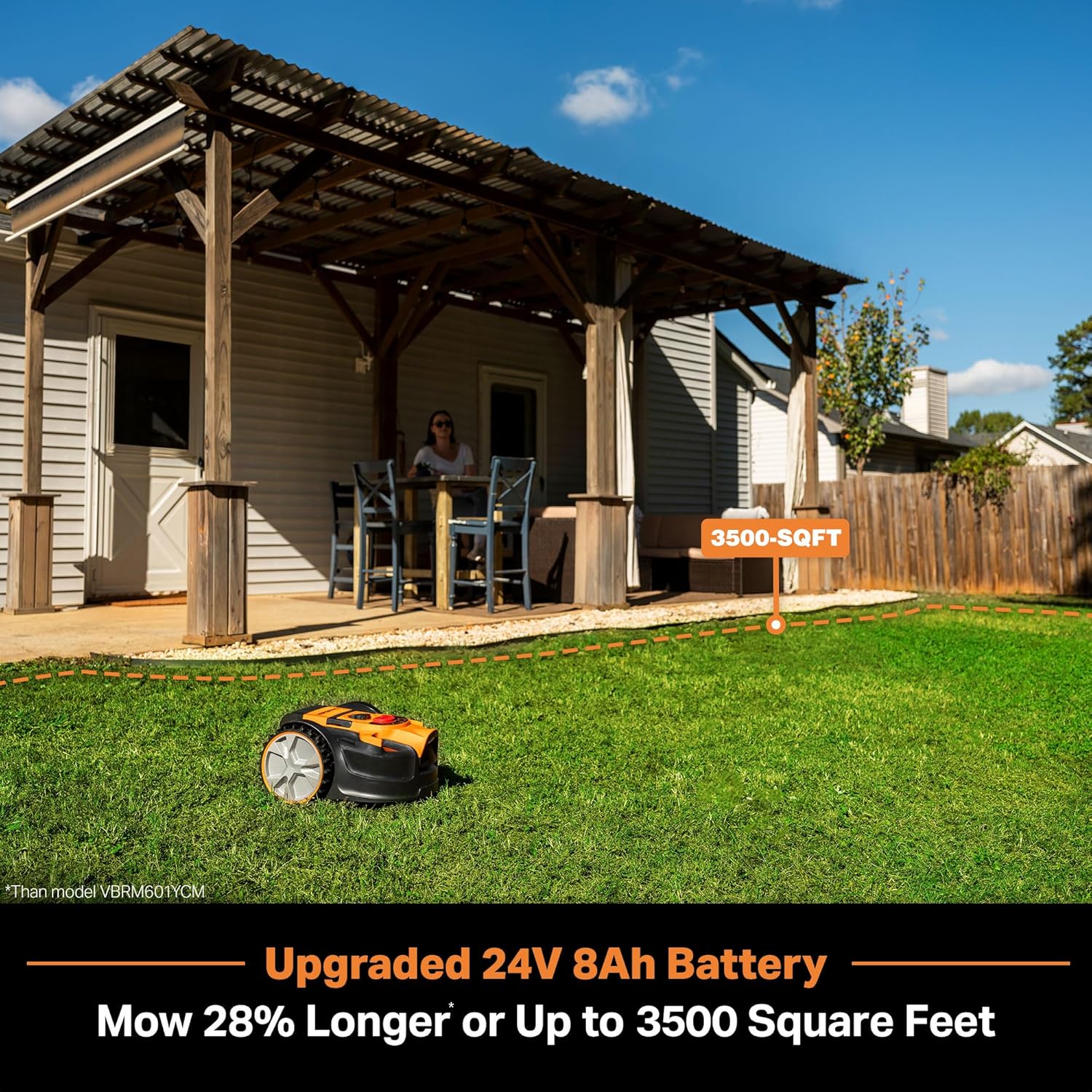
The LawnMaster OcuMow carves a different niche at the lower end of the price band. Owners consistently flag one practical limitation the product page underemphasizes: the effective mowing strip width is approximately 6 inches per pass in boundary-following mode, which means a yard with complex irregular borders requires substantially more passes to finish cleanly. Reviewers also note the OcuMow routes around tall or dense weeds rather than cutting through them — it steers around obstacles it cannot classify confidently. That is actually a reasonable safety behavior, but it means your first run on an overgrown lawn needs to be preceded by a manual trim.
The ANTHBOT M5 (RTK-based) also surfaces frequently in this segment, with buyers describing setup simplicity relative to Segway’s configuration workflow as its primary differentiator. It belongs in the consideration set for buyers who want RTK accuracy with a lighter app-configuration burden.
LawnMaster
$399.97
In stock on Amazon
Check price on AmazonBy the Numbers
| Mower | Navigation | Rated Coverage | Slope Limit | Est. Street Price (mid-2026) |
|---|---|---|---|---|
| Segway Navimow i105N | RTK GPS | 0.27 ac (1,100 m²) | 45% | ~$699–$799 |
| Sunseeker X7 | RTK GPS | 0.25 ac (1,000 m²) | 45% | ~$699–$749 |
| ECOVACS Goat O1000 LiDAR PRO | LiDAR | 0.25 ac (1,000 m²) | 35% | ~$799–$899 |
| WORX Landroid Vision | Optical/AI | 0.20 ac (830 m²) | 35% | ~$699–$799 |
| LawnMaster OcuMow | Optical | 0.25 ac (1,000 m²) | 30% | ~$499–$599 |
Manufacturer-rated figures per published spec sheets; owner-reported real-world coverage typically runs 15–20% lower on complex yard shapes.
Setup Realities Nobody Puts in the Box
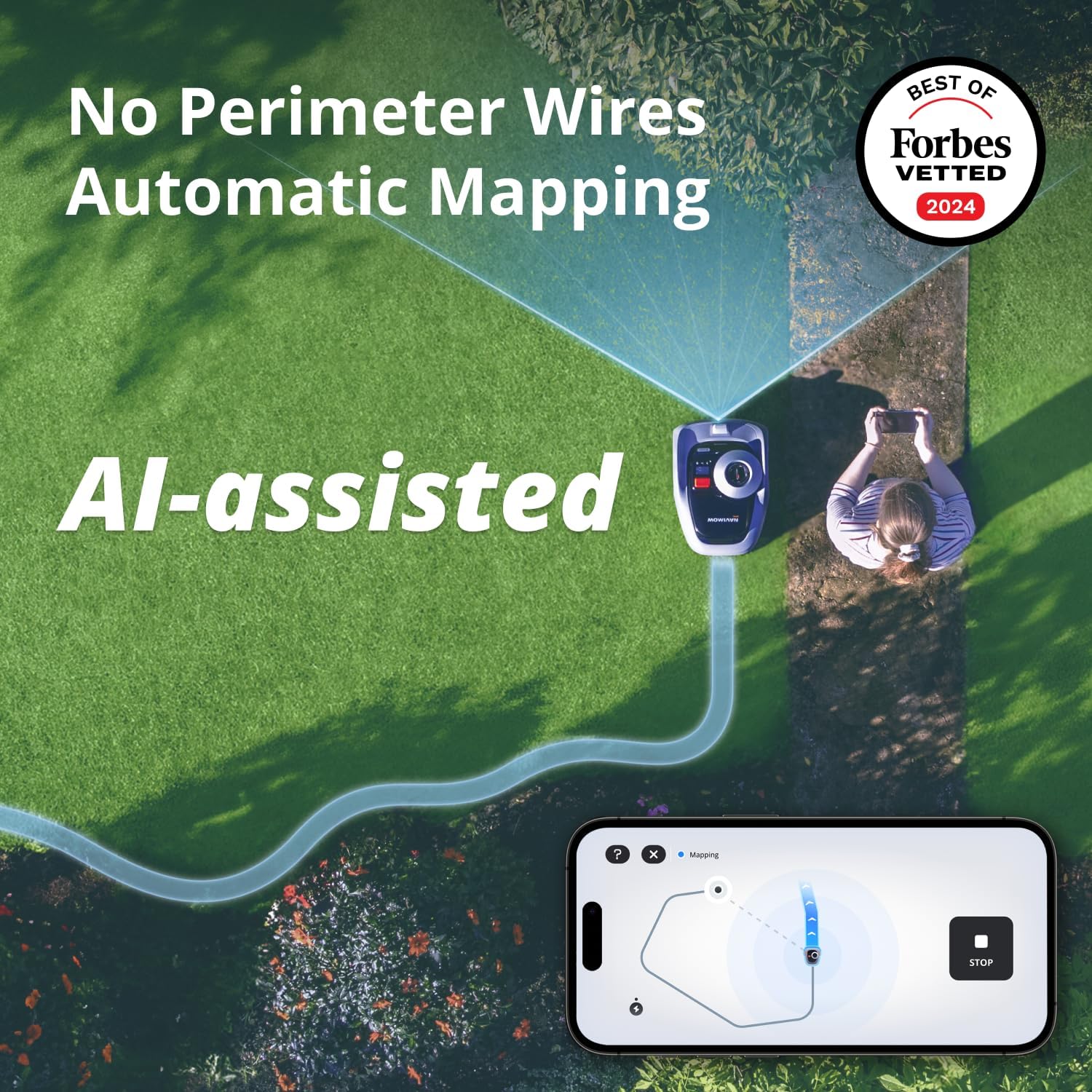
Initial mapping time is the most underestimated variable in wire-free mower ownership. RTK units require GPS fix acquisition before mapping begins — in good sky-view conditions this takes 5–15 minutes per session, but owners with complex multi-zone yards (garden beds, trees, pool surrounds) report 2–4 mapping sessions spread across multiple days to get the boundary map accurate. The Segway Navimow app workflow requires you to physically walk the boundary while the mower follows, so your mapping session doubles as a walking audit of your yard’s edge conditions.
LiDAR mapping on the Goat O1000 is largely self-directed — the unit drives itself while building the map — but the map requires several real mowing cycles to stabilize. Budget the first week as a refinement period rather than expecting a finished result on day one.
Vision mapping on the Landroid Vision is the most conditions-sensitive of the three. The failure-and-retry rate is higher than either RTK or LiDAR, so budget a full half-day for first setup regardless of navigation type. For the Landroid Vision, that half-day buffer is essential, not optional. Do not update firmware mid-run; a failed update can require a complete re-mapping session.
Slopes, obstacles, and irregular borders each carry specific implications. On grades in the 30–40% range, RTK units handle slope most reliably because the navigation logic does not degrade with visual noise on steep terrain. LiDAR units perform well on moderate slopes, but owners note that point-cloud map quality can shift on steep grades where the laser’s horizontal scan plane begins capturing more sky than lawn. Vision units are the least reliable on steep grade changes where lighting and visual contrast also shift simultaneously.
Yards with trees, garden beds, and irregular borders favor LiDAR in the owner record. The Goat O1000’s ability to map static obstacles autonomously and route around them is consistently well-regarded. RTK mowers navigate accurately to the boundary but navigate around mid-yard obstacles only through manually defined exclusion zones in the app. You’ll need to walk those zones deliberately during setup. Vision units need clear visual contrast between lawn and border — beds with dark mulch photograph well; beds that blend into lawn color are harder for the classifier.
Tall or overgrown grass on first run: none of these mowers are mulching tractors. Every navigation category’s review corpus includes warnings about first-run height limits. Manufacturers generally recommend no more than 4 inches of grass height on initial mapping runs. If you’re starting from an unmowed state, do one manual pass with a conventional mower first.
Frequently Asked Questions
Where exactly should I mount the RTK antenna for best satellite signal? Aim for the highest point on your property with an unobstructed view of as much sky as possible — ideally 360 degrees above a 15-degree horizon angle. A south-facing exposure in the Northern Hemisphere captures the most satellite geometry. Avoid mounting within 3 feet of metal structures, which cause multipath signal reflection errors. The Robot Report’s 2025 antenna-siting analysis supports height and sky-clearance as the two variables that matter most.
How long does initial lawn mapping actually take? Plan for a half-day on your first setup attempt. RTK boundary walking for a quarter-acre lawn typically takes 30–60 minutes once GPS fix is solid. LiDAR autonomous mapping takes similar clock time but less physical effort. Vision mapping is fastest in ideal conditions but carries a higher failure-and-retry rate, so the half-day buffer applies regardless of navigation type.
Will a robot mower handle a 30–45% slope? At 30%, most of these units operate within their rated limits, though wet grass is a documented slip risk across all navigation types. At 40–45%, only RTK units rated to 45% (Navimow i105N, Sunseeker X7) are in-spec. Owners recommend verifying traction on a manual test run before setting unattended schedules.
What happens if a firmware update fails mid-season? RTK and LiDAR units typically fail safely — the mower parks, and you restore via the app. Vision units are more sensitive: a failed Landroid Vision firmware update can require a full re-mapping session. Screenshot your app’s boundary map before any update.
Can these mowers handle tall or overgrown grass on the first run? No. Pre-mow manually to under 4 inches before first use. The OcuMow will route around tall obstacles it cannot classify; RTK and LiDAR units will attempt to cut but owners report motor strain on heavily overgrown lawns.
The Decision Framework
If your yard has clear sky exposure and slopes above 35%: RTK is your navigation type. The Segway Navimow i105N and Sunseeker X7 carry the most substantive owner data for that profile. Antenna placement is your primary setup variable — get that right and the system works reliably. The ANTHBOT M5 is worth evaluating if you want RTK accuracy with a lighter app-configuration workflow.

Sunseeker
$1,884.00
In stock on Amazon
Check price on AmazonIf edge accuracy around beds and borders is your top priority and your yard has significant mid-lawn obstacles on relatively flat terrain: LiDAR’s autonomous obstacle mapping on the ECOVACS Goat O1000 LiDAR PRO is the differentiator. Accept that light-condition edge cases exist and treat the first two weeks as a map-refinement period rather than expecting finished performance from day one.
Segway
$799.00
In stock on Amazon
Check price on AmazonIf you have a simple, moderate-grade yard and want the lowest entry price: The LawnMaster OcuMow’s optical navigation works within its constraints. Pre-trim before first use and accept the narrower boundary-following strip width on complex borders. At $499–$599 it is meaningfully cheaper than anything else in this comparison.
LawnMaster
$399.97
In stock on Amazon
Check price on AmazonIf you’ve already returned a robot mower for signal loss or getting stuck on grade changes: The RTK owner reviews on the Sunseeker X7 and ANTHBOT M5 are populated with exactly your situation. Those first-person return-and-upgrade narratives are the most useful comparison data in the category right now, and they point consistently toward RTK as the recovery choice.
The wire-free market under $1,000 is genuinely competitive in mid-2026 in a way it was not 18 months ago. Robotics and Automation News, in its “Wire-Free Robot Mowers: Market Survey Q1 2026,” documented that sub-$800 RTK units represent a category that essentially did not exist at accessible consumer pricing in 2023. The technology works — the question is matching the navigation approach to your specific yard geometry, sky exposure, and patience budget for setup.